
Thread Transfer
Warehouse Picking Errors: The Root Causes That Are Not Training
A mispick is not a mistake — it is a system producing the outcome its design makes most likely. At $74 direct cost each, here is where they actually come from and which fixes are nearly free.
Thread Transfer
Operations Systems for SMBs
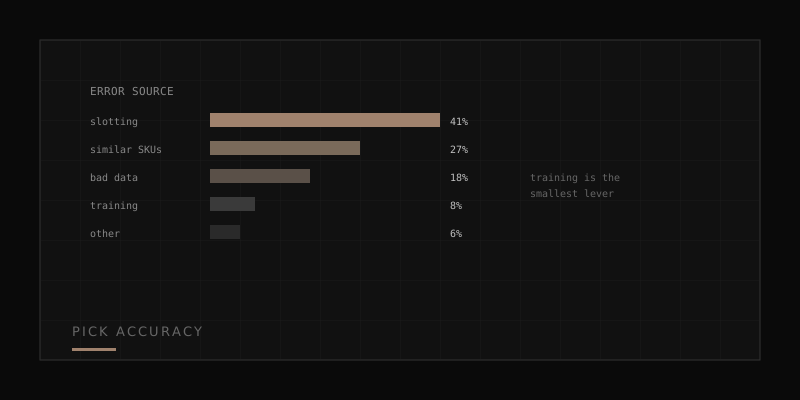
When a warehouse ships the wrong item, the response is almost always the same: a conversation with the picker, a note about being careful, and possibly a refresher session. Six weeks later the error rate is exactly where it was. This is not because the picker ignored the conversation. It is because picking errors are overwhelmingly generated by the environment the picker is standing in, and no amount of carefulness overcomes a layout that makes the wrong action easier than the right one.
The useful reframe: a mispick is not a mistake. It is a system successfully producing the outcome its design makes most likely.
What a Mispick Actually Costs
Most operations price a mispick as the replacement shipping cost. That is the smallest component. The full cost of a single wrong-item shipment to a business customer:
| Cost element | Typical value |
|---|---|
| Return shipping | $14 |
| Replacement outbound shipping | $14 |
| Customer service handling (25 min) | $18 |
| Re-pick, re-pack, re-despatch | $11 |
| Receiving and re-stocking the return | $8 |
| Inventory record corruption (two SKUs now wrong) | Unmeasured, compounding |
| Credit note and admin | $9 |
| Direct cost per mispick | ~$74 |
At 25,000 order lines a year and a 0.6% error rate — which is unremarkable for a manual paper-pick operation — that is 150 mispicks, or roughly $11,000 in direct cost. The indirect cost is larger and harder to argue with: a B2B customer who receives two wrong deliveries in a quarter starts dual-sourcing, and you never learn that is why volume drifted.
The Five Causes, in Order of Actual Frequency
When operations instrument mispicks properly — recording what was picked, what should have been picked, where both items live, and who picked them — the distribution is remarkably consistent across businesses.
1. Slotting adjacency (roughly 40%)
The single largest cause. Two similar SKUs stored next to each other. The picker reaches for the correct location and takes from the bin beside it, because the visual difference between the items is smaller than the visual difference between the bin labels. This is not inattention; it is a predictable perceptual failure that the layout invites.
The fix is free: separate confusable SKUs physically. Sizes of the same product should never be adjacent. Colour variants should never be adjacent. If two items differ only by a suffix in the SKU code, they must not share an aisle face.
2. Ambiguous item identity (roughly 25%)
The pick list says "Bracket, 40mm, galv." There are three brackets that could plausibly be described that way, and the difference is on the packaging in six-point type. The picker resolves the ambiguity by guessing, correctly most of the time.
The fix is a scan-verify step and pick lists carrying a discriminating attribute — the thing that distinguishes this item from its nearest neighbours, not the item's full formal description.
3. Stale or wrong data (roughly 18%)
The pick list sends the picker to a location the item left three weeks ago. They find something in that bin and take it. Or the system says eleven units are available, there are four, and the shortfall is silently under-shipped rather than flagged.
This category is where picking accuracy and inventory accuracy stop being separate problems. A warehouse with 91% inventory record accuracy cannot achieve 99.5% pick accuracy — the data is wrong before anyone reaches for anything.
4. Quantity errors (roughly 9%)
Right item, wrong count. Concentrated in unit-of-measure confusion: the system holds eaches, the shelf holds boxes of twelve, and the pick list says "6" without saying six of what. Boxes-versus-eaches is one of the most reliable error generators in small warehouses and one of the easiest to eliminate by printing the unit on every line.
5. Genuine attention lapses (roughly 8%)
The category everyone starts with turns out to be the smallest. It is real, it correlates with fatigue and interruption, and it responds to workload design far better than to instruction.
The Diagnostic Nobody Runs
Almost no small warehouse records what was actually picked when an error occurs. The return comes back, the correct item goes out, the credit is raised, and the event leaves no analysable trace. Without the pair — item picked and item required — you cannot see adjacency patterns, and adjacency is 40% of your problem.
Start recording six fields on every mispick. This costs about ninety seconds per event and pays for itself within a month:
- SKU required and SKU actually shipped
- Bin location of each
- Order line quantity and quantity shipped
- Picker, date, shift, and time of day
- Whether the item was scanned at pick
- Order size — number of lines on that pick
Two patterns emerge fast. First, a small number of SKU pairs will account for a disproportionate share of errors — usually the ones stored adjacently. Second, error rate correlates strongly with lines per pick, not with picker identity. Errors cluster in large multi-line picks regardless of who performs them.
Fixes Ranked by Return
| Intervention | Cost | Typical error reduction |
|---|---|---|
| Separate the top 20 confusable SKU pairs | A day of labour | 25-35% |
| Print discriminating attribute on pick lines | A report change | 10-15% |
| Print unit of measure on every line | A report change | 5-8% |
| Barcode scan-verify at pick | Scanners plus a system change | 50-70% |
| Cycle counting to raise data accuracy | Process, ongoing | 10-18% |
| Cap lines per pick, batch instead | Free, process change | 8-12% |
| Retraining alone | A day plus disruption | 0-5%, decays in weeks |
The last row is the one most businesses reach for first and it is the worst-performing intervention on the list. The first three rows are nearly free and collectively address roughly half the problem.
Scan-Verify Is the Step Change
Everything above is optimisation. Barcode verification at the point of pick is categorical: it converts picking from a memory-and-attention task into a confirmation task. The picker scans the item; the system either accepts it or refuses. Adjacency errors, identity ambiguity, and attention lapses all collapse at once, because the system checks rather than the human.
The objection is always cost, and the cost is usually overestimated. Consumer-grade scanners or a phone camera handle a small warehouse fine. The real requirement is not hardware — it is that your inventory system can accept a scan against a specific pick line in real time, in a location where operators have no desk.
That is exactly where off-the-shelf inventory tools tend to stop for smaller businesses. They will hold your stock levels perfectly well and offer no mechanism to verify a physical action against a specific order line on the warehouse floor. It is the reason a purpose-built inventory automation system is frequently a better answer than another subscription — the pick-verify loop has to match your actual layout, units of measure, and packing rules, and generic tools model an average warehouse that resembles nobody's.
Layout Rules Worth Adopting
Independent of any system change, these slotting rules reduce errors and cost nothing but a weekend:
- Never store variants adjacently. Sizes, colours, voltages, lengths. Separate by at least one bay.
- Velocity to the golden zone. Fastest movers between knee and shoulder height near despatch. Reduces travel and fatigue, and fatigue is what turns near-misses into errors.
- One SKU, one primary location. Multiple active locations for the same item multiply both mispicks and count variances.
- Label the bin, not just the shelf. Large, high-contrast, at eye level, with the discriminating attribute — not a fourteen-character code differing in the last two characters.
- Physical break between similar families. An empty bay or a coloured divider between confusable ranges genuinely works.
Set a Target and Report It Weekly
Most small warehouses do not know their pick accuracy. Measure it as lines picked correctly divided by total lines picked, weekly.
| Pick accuracy | Assessment |
|---|---|
| Below 98% | Structural problem — expect visible customer churn |
| 98.0 - 99.0% | Typical manual paper-pick operation |
| 99.0 - 99.5% | Good manual process with strong slotting |
| 99.5 - 99.9% | Scan-verified |
| Above 99.9% | Scan-verified plus weight or dimension checks |
A move from 98.5% to 99.5% on 25,000 lines removes 250 mispicks a year — about $18,500 in direct cost, before counting the customers you keep.
The Broader Pattern
Picking accuracy is a good example of a general truth about operations: the visible failure is nearly always downstream of an invisible design decision. The picker is the last human to touch the order, so the error gets attributed to them. The actual cause was chosen months earlier by whoever decided where things go on the shelf and what appears on a printed line.
If mispicks are costing you and the usual conversations have not moved the number, the constraint is structural. Mapping structural constraints across a whole operation — picking, counting, purchasing, despatch, reporting — is the point of the Operations Leak Audit at opsmavix.com. Ninety minutes, written findings, and a ranked list of what to fix first.
Learn more: How it works · Why bundles beat raw thread history