
Thread Transfer
Annual Stocktake vs Cycle Counting: Why Your Year-End Count Is Lying to You
An annual count corrects a number. A cycle count corrects a system — because a variance found within 48 hours is a variance you can still investigate. Here is the schedule, the tolerances, and the five reasons most programmes die by month four.
Thread Transfer
Operations Systems for SMBs
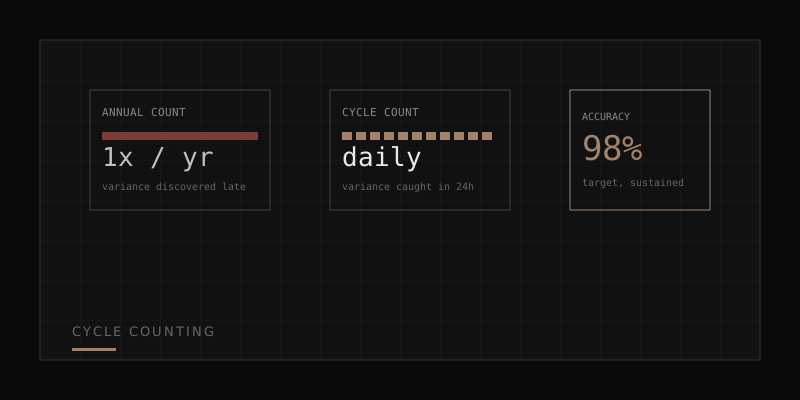
Every year, thousands of small businesses shut the warehouse for two days, hand out clipboards, and count everything they own. Then they discover a variance — usually somewhere between 3% and 11% of inventory value — and book an adjustment that nobody can explain. The finance team calls it shrinkage. The ops team calls it Tuesday. Nobody calls it what it actually is: a twelve-month-old measurement error that has been silently corrupting every purchasing, pricing, and promising decision since the last count.
The annual stocktake is not an inventory control. It is an audit ritual. It tells you what was true on one specific weekend. It tells you nothing about the 363 other days, which is precisely when you were making decisions.
What the Annual Count Actually Measures
A full physical count produces one number: the variance between book stock and physical stock at a single point in time. That number is real. It is also nearly useless for operations, for three reasons.
It arrives too late to act on
If the count reveals you are 400 units short on your highest-velocity SKU, that discrepancy did not appear on count day. It accumulated — through mispicks, unrecorded damages, receiving errors, or theft — across months. By the time you see it, the trail is cold. There is no receiving log to check, no camera footage, no operator to ask. You book the adjustment and move on, having learned nothing that prevents a repeat.
It hides the compounding error
Here is the part that costs real money. Between counts, your system believes it has stock it does not have. So it lets sales promise it. It suppresses reorder triggers because on paper you are covered. You find out at pick time, and now you are cancelling a line, splitting a shipment, or expediting a purchase order at a premium. Every one of those events has a cost, and every one of them traces back to a number nobody had reason to distrust.
It creates a false sense of resolution
After the count, everyone believes inventory is now accurate. It is — for about a week. Then the same processes that caused the drift resume, at the same rate, and accuracy begins decaying immediately. The count fixed the number. It did not fix the process producing the error.
Cycle Counting: The Same Work, Distributed
Cycle counting counts a small subset of SKUs every day, on a rotating schedule weighted by value and velocity, without stopping operations. Over a quarter, everything gets counted. High-movers get counted eight or ten times.
The total labour is roughly the same as an annual count — often less, because you are not paying overtime for a weekend shutdown. The difference is entirely in when you learn about a variance.
| Dimension | Annual stocktake | Cycle counting |
|---|---|---|
| Time to detect a variance | Up to 12 months | 1-30 days |
| Root cause traceable? | Almost never | Usually |
| Operations disruption | 1-3 days shutdown | None |
| Accuracy between counts | Decays all year | Held at a steady state |
| Cost of counting labour | Concentrated, often overtime | Spread, absorbed in normal shifts |
| What it improves | The closing balance | The process |
That last row is the whole argument. An annual count corrects a number. A cycle count corrects a system, because a variance found within 48 hours is a variance you can still investigate.
The ABC Schedule (And Why Most SMBs Get It Backwards)
The standard approach classifies SKUs by annual consumption value. A-items are the ~20% of SKUs driving ~80% of value, and they get counted most often.
| Class | Share of SKUs | Share of value | Count frequency |
|---|---|---|---|
| A | 15-20% | 70-80% | Monthly or fortnightly |
| B | 25-30% | 15-20% | Quarterly |
| C | 50-60% | 5-10% | Twice yearly |
The mistake we see constantly: classifying by unit cost instead of annual consumption value. A $900 machine part sold twice a year is not an A-item. A $4 fastener consumed 60,000 times a year probably is — because that is where the error volume lives, and error volume is what you are trying to catch.
Add a velocity override
Pure value-based ABC misses a category that causes disproportionate pain: fast-moving, low-value items that are constantly touched. Every touch is an error opportunity. A practical rule that outperforms textbook ABC in small operations: count anything in the top 50 by pick frequency at least monthly, regardless of class.
Why Cycle Counting Fails in Practice
Most SMBs that try cycle counting abandon it within four months. The failure is almost never conceptual. It is operational, and it is usually one of these five.
1. The count list is generated manually
Someone has to decide which 15 SKUs get counted today. If that decision is a spreadsheet someone maintains by hand, it will drift, then lapse, then stop. The schedule has to generate itself.
2. There is no way to record a count where the stock is
If the counter writes on paper and someone re-keys it into the system that afternoon, you have added a transcription error to a process whose entire purpose is eliminating errors. Counts must be entered at the shelf.
3. Variances have no workflow
A variance is found. Now what? If the answer is "tell Dave," it dies. A variance needs to become a record with an owner, an investigation status, and a resolution — otherwise you are just documenting your losses more frequently.
4. Nobody is accountable for the accuracy number
If no one owns "inventory record accuracy" as a metric with a target, cycle counting is perceived as unpaid extra work and will lose every contest against picking and despatch.
5. The system cannot freeze a location mid-count
Count bin A14, and while you are counting, someone picks from A14. Your variance is now fictional. Without a soft freeze, cycle counts in an active warehouse generate noise that destroys trust in the whole programme.
Notice that four of those five are systems problems, not discipline problems. This is the pattern OpsMavix sees repeatedly across inventory-heavy SMBs: the process is sound, and the tooling makes the process impossible to sustain.
What Good Looks Like
A working cycle-count programme has six mechanical properties. If your setup is missing more than two, the programme will not survive contact with a busy quarter.
- Self-generating daily list. Ranked by class and days-since-last-count. Nobody decides; the system decides.
- Mobile entry at the shelf. Phone or scanner. Blind counts by default — the counter does not see the expected quantity, or they will unconsciously confirm it.
- Location freeze during count. Picks from that bin queue or divert for the few minutes it takes.
- Tolerance-driven escalation. Small variances auto-post. Anything past a threshold — by value or percentage — creates an investigation record and does not post until closed.
- Root-cause tagging. Every closed variance is tagged: receiving error, mispick, damage, unit-of-measure confusion, theft, system error. After ninety days the tag distribution tells you exactly where to spend fixing effort.
- A tracked accuracy metric. Inventory Record Accuracy — the percentage of counted locations within tolerance — reported weekly, with a target of 97-98% for a small operation.
None of this requires an enterprise WMS. All of it requires that your inventory data lives somewhere a workflow can be attached to, which is exactly where spreadsheet-based operations hit a wall.
The Spreadsheet Ceiling
You can run cycle counting in a spreadsheet for a while. Small SKU count, one location, one person doing all the counting — it works. It stops working at a predictable set of thresholds:
| Trigger | What breaks |
|---|---|
| Second stock location | Per-location quantities and transfers-in-transit |
| More than one counter | Concurrent edits, version conflicts |
| Counting during trading hours | No freeze, so every variance is disputed |
| SKUs past ~800 | Manual scheduling collapses |
| Variance investigations | No status, no owner, no audit trail |
The usual next step is buying inventory software. Sometimes that is right. Often it is not, because the off-the-shelf tools assume a warehouse shaped like the average of all their customers, and your bottleneck lives in the part that is not average — the consignment stock at a customer site, the assemblies that consume components at despatch, the supplier who ships in cases but invoices in units.
The alternative is a purpose-built inventory automation system shaped around how your operation actually moves stock: your locations, your units of measure, your tolerance rules, your escalation path. Built once, owned outright, with no per-seat pricing and no roadmap dependency on a vendor who has never seen your warehouse.
A 30-Day Starting Point
You do not need a system to begin. You need a system to sustain it — but the first month can be run manually, and it will tell you whether the effort is justified.
- Days 1-3. Pull twelve months of consumption. Rank SKUs by annual value. Draw the A/B/C lines. Flag the top 50 by pick frequency as forced-A.
- Days 4-5. Set tolerances. A common starting pair: 2% by quantity for C-items, zero tolerance by value above $250 for A-items.
- Days 6-30. Count ten A-items every working day. Blind. Record the variance and tag a root cause every single time, even when you are guessing.
- Day 30. Tabulate the tags. In almost every operation, one or two causes account for over 60% of variance events. That is your fix list, and it is now evidence rather than opinion.
What you will find, reliably, is that variance is not evenly distributed. It clusters — in one receiving process, one product family, one shift, one badly slotted aisle. The annual count averages that signal into a single meaningless number. Cycle counting surfaces it in weeks.
The Real Return
Businesses justify cycle counting on shrinkage reduction. That is the smallest benefit. The real returns are downstream, and they are larger:
- Purchasing stops over-ordering. Buyers who do not trust stock figures pad every order. Trustworthy numbers release working capital immediately.
- Sales stops over-promising. Available-to-promise becomes real, so short-ships and cancellations fall.
- The annual count gets cheaper — or disappears. Many auditors will accept a well-documented cycle-count programme in place of a full physical count.
- Fixes become targeted. You stop retraining everyone about "being careful" and start fixing the two processes actually generating errors.
The count was never the point. The feedback loop was.
Where to Start if Counting Is Not Your Only Problem
Inventory accuracy is rarely broken in isolation. It usually sits alongside a purchasing process running on email, a despatch process that records nothing until invoicing, and a reporting cycle that surfaces problems a week after they became expensive. Fixing the count alone leaves the rest of the leak open.
That is the reasoning behind the Operations Leak Audit at opsmavix.com — a 90-minute structured diagnostic that maps where your operation is actually losing time and margin, and which two or three fixes are worth doing first. You get the written findings either way. If the answer is "start cycle counting and change nothing else," that is a perfectly good outcome, and it costs you an hour and a half to find out.
Learn more: How it works · Why bundles beat raw thread history