
Thread Transfer
The Quote-to-Cash Handoff: Where SMB Revenue Quietly Leaks
Between the handshake and the bank, 8-12% of delivered value disappears through four handoffs nobody instruments. Here is the 20-job analysis that finds yours, and why the fix is a connective layer rather than another tool.
Thread Transfer
Operations Systems for SMBs
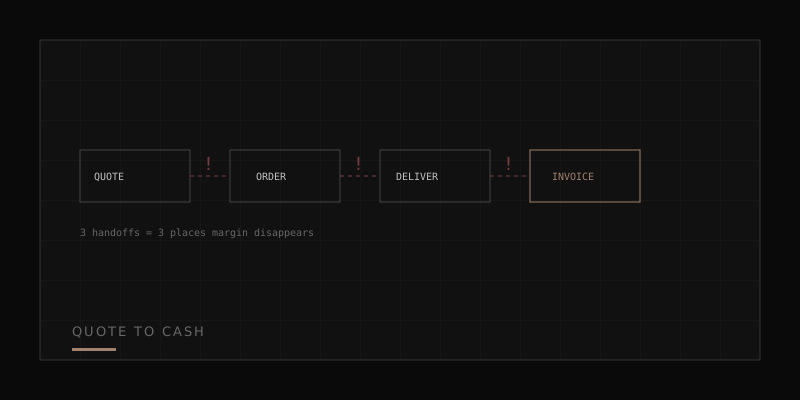
Quote-to-cash is not a process. In most small and mid-sized businesses it is four processes that have never been introduced to each other, connected by a person who remembers things. Sales quotes. Operations delivers. Finance invoices. Somewhere in between, margin evaporates — not in one dramatic loss, but in a hundred small ones that never get attributed to anything, because the accounting system only records the ending, never the drift.
The revealing question to ask an owner is not "what is your average margin?" It is: "When a job comes in 12% under the quoted margin, how long does it take you to find out, and can you tell me why?" In most SMBs the honest answers are "at month-end, maybe" and "no."
The Four Handoffs, and What Falls Through Each
Every quote-to-cash cycle has the same four transitions. Each one is a place where information is supposed to be carried forward and frequently is not.
Handoff 1: Quote to order
The customer accepts. Someone now has to turn a quote — a sales document, written persuasively — into an order, an operational instruction. The quote said "installation included." The order needs to know that means two engineers for six hours plus a lift hire. If the person building the order was not in the sales conversation, that detail is reconstructed from a PDF, and reconstruction is where assumptions enter.
The most common leak here is the unpriced inclusion: something promised verbally to close the deal, never written into the quote line items, and therefore never costed, never scheduled, and never invoiced. It just happens, absorbed silently by operations.
Handoff 2: Order to fulfilment
Now the order becomes work: a pick list, a production job, a service schedule. This is where scope quietly expands. The customer calls the engineer directly and asks for one more thing. The engineer, being helpful, does it. No change order exists, because creating one requires opening a system the engineer does not have on their phone, so the extra work becomes invisible cost.
It is worth being precise about the size of this. A single unrecorded hour on a job quoted at 20 hours at a $95 loaded rate is a 5% margin hit. Two of those per job across a year is often larger than the entire annual profit growth the business is chasing.
Handoff 3: Fulfilment to invoice
The job is done. Someone must now translate what happened into what gets billed. If the record of what happened is a mix of a delivery note, three Slack threads, and an engineer's memory, the invoice will be built from the most convenient source rather than the most accurate. Under-billing is more common than over-billing, because nobody wants to invoice for something they cannot substantiate.
This is the single largest and least-measured leak in the chain. Businesses that instrument it typically find 2-6% of delivered value is never invoiced at all. It is not fraud or incompetence. It is a missing record.
Handoff 4: Invoice to cash
The invoice goes out. Now the clock runs. Disputes at this stage are almost never about price — they are about evidence. The customer asks what a line covers. If producing the answer requires an archaeology expedition through email, the invoice sits unpaid while someone digs, and days sales outstanding climbs for reasons that have nothing to do with the customer's willingness to pay.
| Handoff | Typical leak | Usual size | Visible in accounts? |
|---|---|---|---|
| Quote to order | Unpriced verbal inclusions | 1-4% of job value | No |
| Order to fulfilment | Unrecorded scope creep | 3-8% | No |
| Fulfilment to invoice | Delivered but never billed | 2-6% | Never |
| Invoice to cash | Evidence-driven disputes | 8-20 days of DSO | Partially |
Add the midpoints and you are looking at roughly 8-12% of delivered value lost between the handshake and the bank. For a business doing $4M in revenue at a 22% gross margin, that is a meaningful fraction of the entire profit line, disappearing into gaps between systems.
Why the Usual Fixes Do Not Work
"We will add a step to the process"
Process documentation solves handoffs that fail through ignorance. These handoffs fail through friction. The engineer knows they should raise a change order. Raising it takes four minutes on a laptop they do not have with them, so it does not happen. Adding a step to a document does not reduce friction; it increases it.
"We will buy a CRM that does quoting"
A CRM will improve handoff one and do nothing for two, three, or four, because the CRM's world ends at "closed won." The information that leaks is operational, and it is generated after the CRM stops paying attention.
"We will get everyone using the project tool properly"
Generic project tools model tasks. They do not model money. You can mark a task complete without recording that it consumed six hours of a resource costing $95/hr against a line quoted at four hours. The tool cannot leak-check what it does not represent.
"We will reconcile monthly"
Monthly reconciliation finds the loss after the invoice is issued and the customer relationship has moved on. You cannot re-invoice a job from five weeks ago without an awkward conversation, so the finding gets written off. Detection has to happen before the invoice, or it is just bookkeeping about failure.
The Structural Fix: One Object, Four Views
Every durable fix to quote-to-cash leakage has the same shape. The quote, the order, the delivery record, and the invoice stop being four documents in four systems and become four views of one object. The job has an identity that persists across its whole life, and every event attaches to that identity.
Concretely, that means:
- The quote's line items survive into the order. Not as text — as structured lines carrying cost assumptions, so variance is computable later.
- Any work performed attaches to a line. Time, materials, subcontractor cost, mileage. If it cannot attach to a line, it is flagged as unattributed rather than silently absorbed.
- Scope changes are a first-class record, raised where the work happens. Phone, thirty seconds, two fields: what changed, chargeable yes or no. Not a form on a desktop.
- The invoice is generated from the delivery record, not from memory. Anything delivered and unbilled appears on an exception list before invoicing, not after.
- Margin is computed continuously. Quoted margin versus running actual, visible while the job is live, when repricing or a conversation is still possible.
The last point converts the whole thing from accounting into management. A margin variance discovered on day four of a twenty-one-day job is a decision. The same variance discovered at invoicing is a post-mortem.
What This Looks Like Built
This is the most common build request OpsMavix receives from services and project businesses, and it rarely requires replacing the CRM or the accounting package. Those systems are fine at what they do. What is missing is the connective layer that owns the job as a single entity and pushes to the others.
A typical implementation of a project operations dashboard for a 30-person business covers: quote construction from a costed service catalogue, one-click conversion to an order with assumptions intact, mobile time and materials capture against job lines, a change-order flow that takes under a minute in the field, a pre-invoice exception report, and a live margin view per job and per client. The accounting system still issues the invoice — it just receives a complete and defensible one.
Businesses that run stock alongside services need the same spine extended into materials, which is where a connected inventory layer matters: materials consumed on a job should decrement stock and land on the job cost simultaneously, from one event, not from two people remembering to do two things.
Instrumenting the Leak Before You Fix It
Do not buy or build anything until you have measured. Four weeks of deliberate measurement will tell you which handoff is actually costing you, and it is frequently not the one you assumed.
- Pick twenty recent completed jobs. Mixed sizes, mixed clients, all finished and invoiced.
- For each, reconstruct four numbers: quoted value, quoted cost, actual cost, invoiced value. Reconstruct actual cost honestly — including the hours nobody logged. Ask the people who did the work.
- Compute two variances per job: cost variance (actual minus quoted cost) and billing variance (invoiced minus quoted value).
- Sort by cost variance and read the top five. The pattern will be obvious within twenty minutes of reading.
The distribution of those variances is the diagnosis. If cost variance dominates, your leak is in handoffs one and two — scope and estimation. If billing variance dominates, it is handoff three — you are delivering more than you charge for. If both are small but DSO is long, your problem is handoff four and it is an evidence problem, not a margin problem.
The Uncomfortable Finding
Most owners running this exercise for the first time discover their least profitable clients are not the ones they suspected. The difficult, demanding client who complains loudly is usually priced correctly, because the friction forced attention. The quiet, easy, long-standing client — the one whose scope has crept upward for four years without a single price review — is frequently the one being served at a loss.
That finding is only available when job-level margin is computed consistently. Averaged across the P&L it is invisible. This is why "our overall margin is fine" is one of the more expensive sentences in small business: an acceptable average routinely conceals a profitable half subsidising a loss-making half, and without job-level data you cannot tell which clients belong to which.
Where to Start
Run the twenty-job analysis. It costs a day and it is the highest-yield day of operational work most owners will do this year. If the result shows the leak is structural rather than behavioural — and it usually is — the fix is a connective layer, not a new policy or another tool subscription.
If you would rather have someone map it with you, the Operations Leak Audit at opsmavix.com does exactly this: 90 minutes, structured, written findings, no pitch deck. You leave knowing which handoff is costing you the most and what the smallest fix looks like — whether or not you ever build anything.
Learn more: How it works · Why bundles beat raw thread history