
Thread Transfer
Multi-Channel Inventory Sync: Why Your Stock Numbers Disagree
Shopify says 40, the marketplace says 37, the 3PL says 44. All four numbers are caches of a ledger that does not exist. Here is the one-ledger model, and the test that shows how much phantom stock you carry.
Thread Transfer
Operations Systems for SMBs
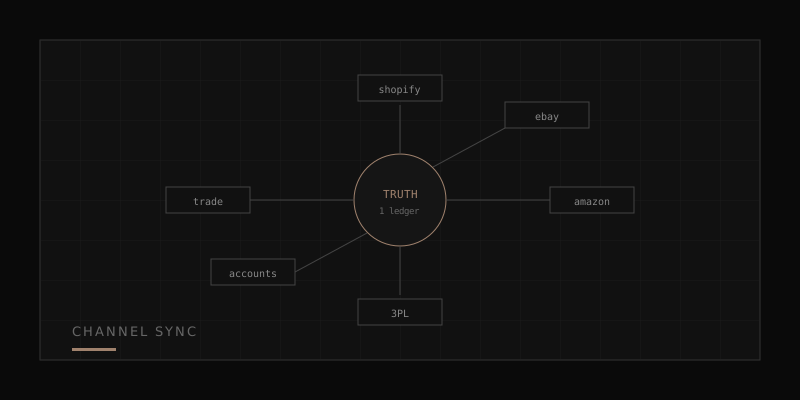
Ask a multi-channel business how much of a given SKU they have and you will get a pause, then a question back: "According to what?" Shopify says 40. The marketplace listing says 37. The 3PL portal says 44. The spreadsheet the trade team works from says 31. Four numbers, four systems, all sincerely reported, none of them correct — because none of them is the ledger. They are all caches of a ledger that does not exist.
That is the actual diagnosis behind almost every multi-channel oversell, and it is why buying a sync tool so often fails to fix it. Sync between caches produces agreement, not truth.
Why the Numbers Diverge
Every channel holds stock you cannot see
The moment a customer adds an item to a basket, most storefronts soft-allocate it. Marketplaces reserve against pending orders. Your trade portal may hold stock against an unconfirmed quote. None of these reservations are visible to the other channels, and they expire on different timers — ten minutes here, sixty there, twenty-four hours somewhere else. Your true available-to-sell is a moving target that no single system can see.
Sync is polled, not instant
Most sync runs on a schedule: every five, fifteen, or sixty minutes. Between polls, every channel is trading on a stale number. For a slow-moving SKU that is harmless. For your bestseller on a promotion day, a fifteen-minute window is enough to sell the same last eight units three times over. Oversells cluster precisely where they hurt most, because velocity and error probability are the same variable.
Returns and inbound land asymmetrically
A return arrives and sits on a receiving bench for two days before anyone books it in. Physically you have stock; systemically you do not. Meanwhile an inbound purchase order gets booked as available on arrival, before QC, so systemically you have stock you cannot actually ship. Both errors are routine, and they push in opposite directions, which is why net variance often looks small while individual SKU errors are large.
Units of measure diverge by channel
You sell singles online, cases of six to trade, and pallets to one large customer. If each channel holds its own notion of a unit and conversion happens in a spreadsheet or someone's head, the numbers cannot reconcile even when the sync is working perfectly.
Nobody owns the buffer
To avoid overselling, someone sets a safety buffer — hold five back from the marketplace. Then someone else sets a different buffer somewhere else. Now you have unquantified phantom stock: units that exist, are sellable, and are invisible to every channel. In inventory-heavy SMBs, accumulated buffers commonly hide 4-9% of sellable stock.
The Cost of Getting It Wrong
| Failure | Immediate cost | Compounding cost |
|---|---|---|
| Oversell on a marketplace | Cancellation fee, refund handling | Seller metrics damage, suppressed listings |
| Oversell on own storefront | Apology, refund, lost margin | Customer does not return |
| Over-buffering | Missed sales, invisible | Capital tied in stock nobody can sell |
| Stale availability | Delayed despatch | Service-level breach with trade accounts |
| Wrong reorder trigger | Emergency purchasing at premium | Supplier relationship strain |
The marketplace row is the dangerous one. Platform penalties for cancellation are not linear — they are step functions. Cross a threshold and listings get suppressed or the account is restricted, and recovery takes months. A sync gap that costs $200 in refunds can cost $30,000 in suppressed visibility.
The Structural Answer: One Ledger, Many Caches
Working multi-channel inventory has one non-negotiable property. One system owns the truth. Every channel is a subscriber. No channel decrements its own count independently; all of them read from, and write events to, the ledger.
Concretely, the ledger owns:
- On-hand by location. Physical units, per site, per bin if relevant. One number, one owner.
- Allocations with expiry. Every reservation from every channel, with a hard timer. A basket hold that expires releases stock automatically rather than leaking it.
- Inbound with confidence. Purchase orders with expected dates and a status — ordered, shipped, received, QC-passed. Only QC-passed counts as sellable.
- Channel policy per SKU. How much of the available pool each channel may see. Deliberate, recorded, reviewable — never an ad-hoc buffer in someone's head.
- Unit conversion. One base unit; every channel's presentation derived from it.
- An event log. Every movement, with source, timestamp, and reason. Without this you cannot diagnose a discrepancy after the fact, only observe it.
The channel policy point is the one that changes behaviour fastest. Instead of a hidden buffer, you state the rule: this SKU exposes 70% of available to the storefront, 20% to the marketplace, and reserves 10% for trade until 4pm. It is explicit, it is testable, and when someone asks why the marketplace shows twelve when you have twenty, there is an answer.
Why Sync Tools Often Disappoint
Off-the-shelf multi-channel sync tools do real work, and for a straightforward operation — one warehouse, singles only, two channels — they are usually the right answer. They struggle at a predictable set of boundaries:
| Situation | Where generic sync breaks |
|---|---|
| Kits and bundles | Component availability rarely computed correctly |
| Assemble-to-order | No concept of buildable-from-components |
| Multiple units of measure | Case, pallet, each conversions unsupported or fragile |
| Trade accounts with allocations | Customer-specific reservations not modelled |
| Consignment or customer-held stock | Owned but not on-site is unrepresentable |
| Split fulfilment across sites | Sourcing rules too simple |
The pattern is consistent: generic tools model the common case well and treat your specific case as an exception to be handled by a human with a spreadsheet. That spreadsheet then becomes the fifth disagreeing number.
Where the exceptions are the business — kits, trade allocations, mixed units — a purpose-built ecommerce inventory automation layer that owns the ledger and treats each channel as a subscriber is usually cheaper over three years than the tool subscriptions plus the human patching them. This is a standard build for OpsMavix across storefront, marketplace, 3PL, and trade channels operating from one ledger.
Diagnosing Your Own Situation
Before changing anything, run this test. It takes two hours and gives you a defensible number.
- Pick your twenty highest-velocity SKUs.
- At a fixed moment, record what every system says. Storefront, each marketplace, 3PL or WMS, accounting, and any spreadsheet in active use. Same minute.
- Physically count all twenty. Including anything on the returns bench and anything received but not booked in.
- Build the grid. Twenty rows, one column per system, plus the physical count.
Two things become visible immediately. The spread — the gap between the highest and lowest system for each SKU — tells you how much phantom or oversold stock you are carrying. And the direction tells you which system is systematically wrong and in which direction, which usually identifies the broken process in a single glance.
A spread above 10% on your top sellers means you are certainly overselling on busy days and certainly holding invisible stock on quiet ones. Both are happening at the same time, which is why the net number never looks alarming enough to act on.
Interim Fixes That Do Not Require a Build
If a ledger is a quarter away, these reduce damage now:
- Make buffers explicit and documented. One list, one owner, reviewed monthly. Unwritten buffers are the largest source of invisible stock.
- Shorten the sync interval on your top 50 SKUs only. Frequency where velocity is; leave the long tail on a slow cycle.
- Book returns within four hours. A returns bench is an unrecorded warehouse.
- Do not mark inbound sellable until QC passes. One status field prevents a whole class of oversell.
- Cycle count the top 50 weekly. Sync propagates whatever it is given; feed it correct numbers.
The Question to Answer First
Not "which sync tool should we buy," but "which system is allowed to be wrong?" Every multi-channel operation has an implicit answer, usually unexamined. When the storefront and the 3PL disagree, which one wins? If the answer is "whichever one someone checks first," you do not have an inventory system — you have four opinions and a hope.
Naming the ledger, even before building one, changes behaviour within a week. If working out where your operation actually loses stock, time, and margin would be more useful than another subscription, the Operations Leak Audit at opsmavix.com maps it in 90 minutes and gives you the written findings regardless of what you do next.
Learn more: How it works · Why bundles beat raw thread history