
Thread Transfer
Job Costing for Small Manufacturers: Knowing Your Margin Before the Job Ships
A shop reporting a 22% average routinely finds jobs from minus 5% to plus 48%. Setup, rework and scrap are where estimates break — and month-end costing tells you six weeks after you could have done anything.
Thread Transfer
Operations Systems for SMBs
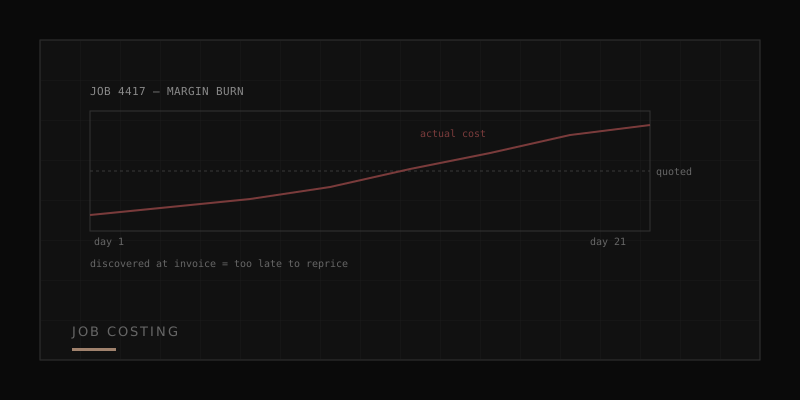
Most small manufacturers can tell you their gross margin for last quarter. Very few can tell you their margin on job 4417, which shipped on Tuesday. The gap between those two facts is where small manufacturing businesses quietly go wrong: they know the average and not the distribution, so they keep taking the work that loses money because it is hidden inside an aggregate that looks acceptable.
Job costing is the discipline of closing that gap. Done properly it is not an accounting exercise performed after the fact. It is a live operational signal that arrives while the job is still on the floor and something can still be done about it.
The Four Numbers a Job Needs
A job that can be costed carries four values, and most small manufacturers reliably capture only two.
| Number | When set | Usually captured? |
|---|---|---|
| Quoted price | At quote | Yes |
| Estimated cost | At quote | Sometimes, rarely retained |
| Actual cost | During production | Partially, late |
| Invoiced value | At despatch | Yes |
The two weak rows are the two that matter. Estimated cost is often computed in a spreadsheet, used to produce a price, and then discarded — so there is nothing to compare against later. Actual cost is assembled at month-end from timesheets and purchase invoices, by which point the job shipped a fortnight ago.
Without a retained estimate you cannot compute variance. Without timely actuals you cannot act on it. The result is a business that knows it made 19% overall and has no idea which jobs made 40% and which made minus 8%.
What Actually Goes Missing
Setup and changeover time
Estimates are typically built from run time — the machine takes eleven minutes per part, times 300 parts. Setup is where estimates break. A two-hour changeover on a 55-hour job is 3.6% of cost, and it does not scale with quantity, which means short runs are systematically underpriced. Manufacturers who quote from run-rate alone lose money on small batches with near-perfect consistency and usually conclude that small customers are unprofitable, when the real cause is an estimating method that ignores fixed cost per job.
Rework
Rework is the most under-recorded cost in small manufacturing. It happens, it gets fixed, and it is logged as normal production time because logging it as rework feels like an accusation. Operations that begin recording rework honestly typically discover it consumes 4-9% of productive hours, concentrated in a small number of part numbers and process steps — a targeted, fixable problem that was invisible while it was averaged into standard time.
Material yield and scrap
The estimate assumes 100% yield. Reality involves offcuts, spoilage, and the third attempt at a difficult weld. If scrap is not attributed to the job that produced it, it lands in a general variance account and the jobs generating it look fine.
Indirect labour attached to specific jobs
Programming, fixture-making, first-article inspection, and the two hours the supervisor spent on the phone with a customer about a tolerance question. These are real, job-specific, and almost never recorded against the job. On complex low-volume work they can exceed direct labour.
Expedited purchasing
The material was late, so someone paid a premium plus overnight freight. That premium belongs to the job. It usually lands in a general purchasing overspend and never touches the job that caused it.
Why Month-End Costing Is Too Late
The standard small-manufacturer pattern: jobs run, timesheets are collected, purchase invoices arrive, and at month-end the bookkeeper allocates everything. Costs land on a job three to six weeks after the work happened, and by then four things are already true.
- The job has shipped and been invoiced at the quoted price. Nothing can be repriced.
- The next quote for the same customer has already gone out, using the same wrong estimate.
- Nobody can remember why job 4417 took eleven extra hours, so no root cause is found.
- The same problem is already recurring on jobs currently on the floor.
Compare this to costing that updates as the job progresses. On day four of a twenty-one-day job, actual labour is already 40% of estimate while completion is 15%. That is an actionable signal. You can investigate now, correct the process, warn the customer, or at minimum ensure the next quote reflects reality. The same information at month-end is a history lesson.
The Minimum Viable System
You do not need an MRP implementation to cost jobs properly. You need five mechanisms, and they can be built small.
- A retained estimate, structured. Not a total. Broken into material, setup, run, finishing, and indirect — because variance is only actionable when you can see which component moved.
- Labour capture at the job, by operation. Shop-floor tablet or phone. Start and stop against a job and an operation code. If capture takes longer than fifteen seconds, it will be reconstructed at the end of the shift and the data will be fiction.
- Material issue attached to the job. Issuing material decrements stock and lands cost on the job in one action. Two separate actions guarantees drift.
- A rework code that is not punitive. Rework must be recordable without implying blame, or it will not be recorded. Frame it as process data — because that is what it is.
- A live variance view. Percent complete against percent of estimated cost consumed, for every open job, on one screen, updated continuously.
That last screen changes management behaviour more than any report produced after the fact. It converts costing from a backward-looking accounting output into a live production control.
Where Off-the-Shelf Software Struggles
Small manufacturers usually reach for either accounting software with a job-costing module or an entry-level MRP. Both have real limits for smaller shops.
| Approach | Strength | Where it fails a small shop |
|---|---|---|
| Accounting job-costing module | Ties to the ledger cleanly | Costs land at invoice posting — always retrospective |
| Entry-level MRP | Structured routings and BOMs | Assumes stable BOMs and routings; bespoke work breaks it |
| Spreadsheets | Flexible, free, understood | No live capture, no concurrency, dies past ~40 open jobs |
| Full ERP | Complete | Implementation cost and complexity out of proportion |
The MRP row is the most common disappointment. MRP assumes you make the same things repeatedly from stable bills of materials. A jobbing shop making one-offs and small batches to customer drawings has a new BOM and a new routing on nearly every job, so the system's core value proposition does not apply while its administrative burden fully does.
This is why bespoke production tracking for manufacturers is frequently the better fit for jobbing and mixed-mode shops: model the job the way your shop actually runs it, capture labour and material where the work happens, and compute variance live — without importing an assumption about repeat production that does not hold. OpsMavix builds these as focused systems rather than ERP implementations, typically starting with the single most expensive blind spot.
Reading Variance Properly
Once you have variance data, interpretation matters. A job over estimate is not automatically a problem, and a job under estimate is not automatically good news.
| Pattern | Likely meaning |
|---|---|
| Consistent overrun on one part family | Estimate is wrong — fix the standard, not the shop |
| Overrun on one customer across families | Unpriced customer-specific requirements |
| Overrun concentrated in one operation | Process or tooling problem at that station |
| Random overruns, no pattern | Capture quality is poor — fix data before analysis |
| Consistent underrun | Overpricing; you are losing bids you could win |
| Overrun rising over months | Scope creep or an unadjusted standard cost |
The consistent-underrun row is worth dwelling on. Manufacturers celebrate beating estimates, but systematically beating them means your quotes are inflated and you are losing work you would have made money on. Both directions of variance cost money; only one of them feels like a problem.
Start With Ten Jobs
Before building anything, prove the value on a sample.
- Select ten completed jobs spanning your product mix.
- Reconstruct the true cost of each — including setup, rework, scrap, indirect labour, and any expediting. Talk to the people who did the work; the timesheets alone will understate it.
- Compare to the price charged.
- Sort by actual margin.
The spread is nearly always wider than expected. A shop reporting a 22% average commonly finds jobs ranging from minus 5% to plus 48%. That distribution is the entire argument for job costing: the average was never the point, and the average is all you have been managing with.
If the exercise shows a wide spread and no obvious explanation, the constraint is measurement rather than pricing. Mapping which measurement gaps cost the most is what the Operations Leak Audit at opsmavix.com does — 90 minutes, structured, written findings, and a ranked view of what to fix first.
Learn more: How it works · Why bundles beat raw thread history