
Thread Transfer
SOAP vs Workload Automation: How Service Orchestration Replaces Legacy WLA
Workload automation didn't die. It got rebranded as SOAP, ate event-driven workflows, and now runs half your enterprise's nightly batches. Here's what actually changed.
Thread Transfer
AI Systems for Builders
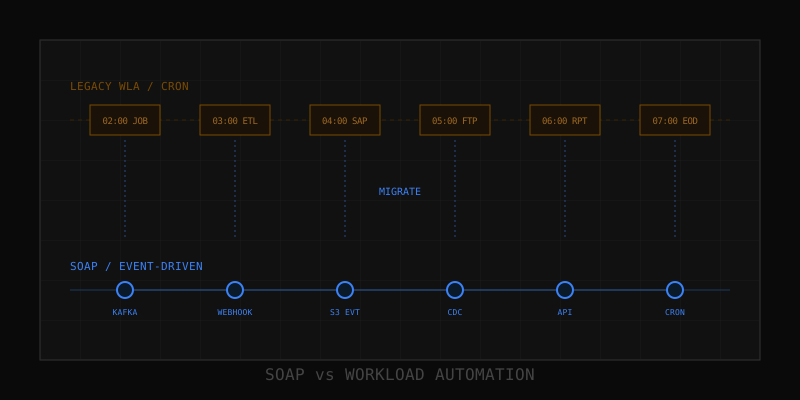
Workload automation didn't die. It got rebranded as SOAP, ate event-driven workflows, and now runs half your enterprise's nightly batches while your platform team argues about Airflow DAGs in a Slack channel nobody in finance reads.
If your shop still has a Control-M, AutoSys, or Tidal instance humming in a colo somewhere, you are running workload automation (WLA). If a vendor recently told you to migrate to their "service orchestration and automation platform" (SOAP), they are selling you the same plumbing with event triggers, REST APIs, and a dashboard that doesn't look like Windows 2003. The argument over SOAP vs workload automation is mostly an argument over which decade your orchestration layer was designed for.
This post unpacks what changed, what didn't, where each architecture wins, and how to migrate without snapping the 1,400 nightly jobs that your CFO doesn't know exist but absolutely depends on.
Workload Automation: The Legacy You Inherited
Workload automation is the descendant of mainframe job scheduling. JCL gave way to Cron, Cron gave way to Autosys and Control-M in the late 90s, and those platforms gave way to enterprise WLA suites that schedule cross-platform batches: SAP runs, ETL jobs, Informatica loads, Oracle EBS month-end, file watchers, FTP drops.
The defining traits of classical WLA:
- Time-based scheduling as the primary trigger. Calendars, fiscal periods, business days.
- Hard dependency graphs. Job B waits for Job A's exit code 0.
- Agent-based execution. A lightweight agent on every server polls the central scheduler.
- Batch-first. Built for nightly windows, not for sub-second event reactions.
- Operator-driven recovery. When something fails at 03:14, a human pages, restarts, and writes a runbook entry.
This worked. It still works. A typical Fortune 500 runs between 8,000 and 60,000 scheduled jobs per day across WLA. The catch: most of those jobs were authored by people who left the company in 2014. The runbooks are SharePoint links that return 404. And the WLA license costs roughly $180–$400 per managed agent per year, so a 600-agent estate is burning $108K–$240K annually before anyone touches the runtime infrastructure.
What SOAP Actually Means in 2026 (And Why the Acronym Fights You)
SOAP, in this context, stands for Service Orchestration and Automation Platforms. Gartner coined the category in 2020 to replace its older WLA Magic Quadrant. The acronym is a war crime because it collides with the SOAP web service protocol from 1998. You will say "SOAP" in a meeting and at least one engineer will assume you mean XML envelopes.
Use the long name when there's ambiguity. Use SOAP when the audience already knows.
A SOAP platform takes the WLA core (scheduling, dependencies, agents) and adds:
- Event-driven triggers. Kafka topics, webhooks, S3 ObjectCreated, database CDC.
- API-first design. Every job, calendar, and dependency is a REST/GraphQL resource.
- Container-native execution. Run jobs on Kubernetes, ECS, Lambda, not just bare-metal agents.
- Cross-cloud orchestration. One workflow can chain AWS Step Functions, Azure Data Factory, and an on-prem AS/400.
- Self-service for app teams. Developers ship workflow definitions via Git instead of filing a ticket.
- Observability beyond exit codes. Tracing, structured logs, SLA dashboards, ML-based anomaly detection.
The vendors you'll see in this space: Stonebranch UAC, Redwood RunMyJobs, ActiveBatch, BMC Control-M (which has rebuilt itself toward SOAP), JAMS, Tidal. Most charge $50–$120 per endpoint per month, plus platform fees. A 600-endpoint SOAP migration runs $360K–$864K per year in license alone — usually higher than the legacy WLA it replaced, which is why the business case has to lean on consolidation and developer velocity, not pure license savings.
Architectural Differences: Triggers, Dependencies, Observability
The cleanest way to see the gap is side by side. This is what changes when you go from WLA to SOAP:
| Dimension | Legacy WLA | SOAP | Practical impact |
|---|---|---|---|
| Primary trigger | Cron / calendar | Event + cron + API | Sub-second reactions to file drops, webhooks, CDC events |
| Execution unit | Agent on VM | Container, Lambda, agent | No more "please install the agent" tickets |
| Dependency model | Static DAG, predecessor exit code | Dynamic DAG, conditional branches, signals | Workflows respond to payload contents, not just success/fail |
| Authoring | GUI, proprietary scripting | YAML/JSON in Git, GUI optional | PR reviews, rollback, diff history |
| Observability | Exit codes, log files | OpenTelemetry traces, structured logs, SLA | MTTR drops from 45 min to <10 min in mature orgs |
| Recovery | Operator manual restart | Auto-retry, idempotent steps, compensating actions | Night-shift call volume drops 60–80% |
| Scope | Batch only | Batch + streaming + API workflows | One control plane instead of three |
Note the last row. The real argument for SOAP isn't that batch scheduling improved — it's that you can finally retire the three separate orchestrators that grew up alongside WLA: the Airflow cluster the data team built, the Step Functions glue the cloud team wrote, and the iPaaS the integration team bought. SOAP eats them all, badly or well depending on the vendor.
SOAP vs WLA vs Orchestrators (Airflow, Dagster, Temporal)
This is where the conversation gets messy. SOAP overlaps with at least four adjacent categories:
Workflow orchestrators (Airflow, Dagster, Prefect)
Open-source DAG runners aimed at data engineering. Excellent for ELT, ML pipelines, dbt orchestration. Weak at cross-platform batch (try running a Cobol job from Airflow), weak at calendar-driven business scheduling (fiscal calendars, blackout windows, manual approvals). Most data teams run Airflow alongside an enterprise WLA, not instead of it.
Durable execution (Temporal, Restate, Inngest)
Built for long-running application workflows: user signup flows, saga patterns, multi-step API choreography. These are developer libraries, not ops platforms. They don't care about your SAP nightly close. SOAP and Temporal coexist — SOAP triggers a Temporal workflow, Temporal handles the application logic.
iPaaS (Workato, Boomi, Mulesoft)
Integration-platform-as-a-service. Strong at SaaS-to-SaaS glue (Salesforce to NetSuite to HubSpot). Weak at batch, weak at infra-level jobs. SOAP can absorb iPaaS use cases; iPaaS can't absorb WLA.
SOA / SOAP-the-protocol
Different thing entirely. Service-Oriented Architecture is a design philosophy from the 2000s. SOAP-the-protocol is XML web services. Neither is what we're talking about. If a vendor pitches you "SOAP" and shows you WSDL files, walk out.
The decision matrix most architects use:
| Need | Best fit |
|---|---|
| Cross-platform enterprise batch + calendars + SLAs | SOAP |
| Pure data pipelines, dbt, ML | Airflow / Dagster |
| Long-running app workflows, sagas | Temporal |
| SaaS-to-SaaS sync | iPaaS or Zapier-class |
| <500 jobs, mostly cron, single cloud | Cron, GitHub Actions, or stay on WLA |
Migration Path from Legacy WLA to SOAP
Most failed migrations die in month four because someone tried to lift-and-shift 14,000 jobs in a big bang. The playbook that actually ships:
Phase 0: Inventory and triage (4–8 weeks)
Export every job definition from your current WLA. You will find that 30–55% of them haven't run successfully in 90 days, haven't logged output in 6 months, or are owned by a cost center that no longer exists. Kill them. The migration just shrank by half.
Phase 1: Parallel run (6–12 weeks)
Stand up SOAP next to the legacy WLA. Replicate one low-risk job stream — usually internal reports or non-critical ETL. Run both in shadow mode. Compare outputs daily. Fix the deltas before promoting.
Phase 2: Wave migration (6–18 months)
Move job streams in waves grouped by business owner, not by technical similarity. Finance close goes together. Supply chain goes together. This keeps stakeholder conversations clean — one owner, one cutover, one rollback plan.
Phase 3: Decommission (1–3 months)
Don't turn off legacy WLA until you have 90 days of clean SOAP runs. Keep the WLA license active but passive. Decommission agents in reverse order of business criticality.
Realistic timeline for a 600-agent estate: 14–22 months end to end. Realistic budget: $1.4M–$3.8M in license, professional services, and internal labor combined. Anyone selling you a six-month migration is selling you a future post-mortem.
Teams that pull this off treat it as part of a broader effort to consolidate their service orchestration layer rather than a one-for-one tool swap. The license number on the contract is the smallest cost in the project.
When You Don't Need Either
Not every shop should be running a SOAP platform. Honest cutoffs:
- Under 200 scheduled jobs total: cron + a thin wrapper (Rundeck, GitHub Actions, AWS EventBridge) is fine. Don't buy a $400K platform to replace a $0 crontab.
- Single-cloud, single-language stack: your cloud provider's native orchestrator (Step Functions, Cloud Composer, Logic Apps) probably covers 90% of needs at 20% of the cost.
- Pure data-engineering shop: Airflow or Dagster, possibly Prefect. SOAP is overkill.
- Startup pre-Series-B: anything you can't express in 200 lines of Python is probably premature.
SOAP earns its license when you have (a) multiple clouds plus on-prem, (b) regulated industries with SLA reporting requirements, (c) business calendars that drive scheduling, or (d) more than 2,000 scheduled jobs with mixed batch and event triggers. Below those thresholds the math gets ugly.
Where This Plugs Into Hyperautomation and LLM-Driven Ops
The interesting frontier in 2026 isn't SOAP itself — it's what sits on top. Several vendors are wiring LLMs into their orchestration layer to do incident triage, suggest workflow refactors, and translate plain-English requests into job definitions. We covered the broader pattern in hyperautomation meets LLMs and in low-code AI automation. The summary: SOAP becomes the deterministic backbone, LLMs handle the fuzzy decision points, and observability data feeds both.
If you're evaluating where to invest, the highest-leverage move is usually to build a unified operations layer first — a single control plane for workflows, runbooks, and on-call — before bolting on AI. Skip that step and you end up with smart agents giving advice about jobs nobody can see.
Key Takeaways
- SOAP is WLA grown up: event triggers, containers, APIs, Git-defined workflows, real observability.
- The acronym is awful. Say "service orchestration platform" in mixed company.
- SOAP doesn't replace Airflow or Temporal. It sits above them and triggers them.
- Realistic migration: 14–22 months, $1.4M–$3.8M for a 600-agent estate.
- Skip SOAP if you have <200 jobs, single cloud, or pure data engineering needs.
- License is the smallest cost. Inventory, parallel runs, and decommissioning are where money and time actually go.
FAQ
How is SOAP different from workload automation?
SOAP is the modern evolution of workload automation. It keeps the scheduling core but adds event triggers, REST APIs, container execution, Git-based authoring, and full observability. Classical WLA is batch-first and agent-bound; SOAP is event + batch and runtime-agnostic.
Is SOAP the same as Service-Oriented Architecture or the SOAP protocol?
No. Different acronym collision. In automation, SOAP stands for Service Orchestration and Automation Platforms, a category Gartner introduced in 2020. It has nothing to do with XML web services or SOA design philosophy.
Do I need SOAP if I already run Airflow?
Usually no, if your workload is purely data engineering. If you also have enterprise batch (SAP, Oracle EBS, mainframe jobs, file-watcher integrations) and business calendar requirements, SOAP complements Airflow rather than replacing it.
What does a SOAP migration actually cost?
For a mid-enterprise estate of 400–800 managed endpoints, expect $1.4M–$3.8M over 14–22 months including license, professional services, and internal labor. License alone runs $360K–$864K per year. Inventory triage typically eliminates 30–55% of jobs before migration, which is where most of the savings come from.
Can I migrate from Control-M to SOAP without rewriting every job?
Most SOAP vendors offer import tools that translate Control-M JIL or AutoSys definitions into their native format with 70–85% fidelity. The remaining 15–30% requires hand conversion, mostly around calendar logic, custom scripts, and dependency edge cases. Budget 6–12 weeks of engineering for the cleanup.
Learn more: How it works · Why bundles beat raw thread history