
Thread Transfer
Meta Ads HIPAA Compliance for US Healthcare Clinics: 2026 Playbook
Meta doesn't sign BAAs, but HHS still expects HIPAA-compliant ads. A 2026 playbook for what's actually legal: Pixel limits, CAPI scrubbing, offline conversions, and the audience hygiene that keeps OCR off your back.
Thread Transfer
AI Systems for Builders
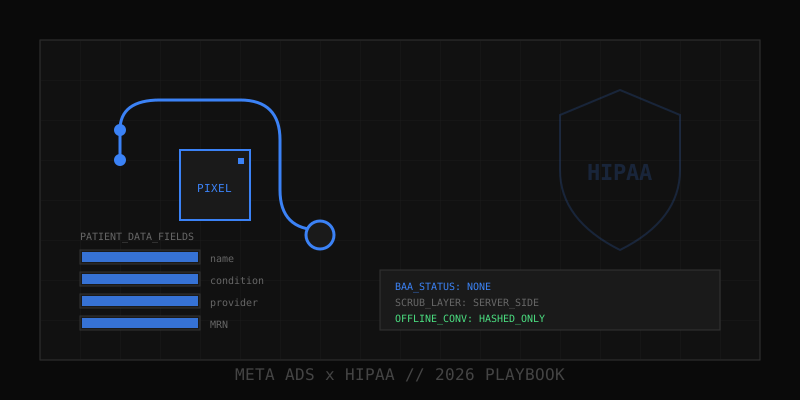
Meta does not sign Business Associate Agreements. They have said this publicly, they say it in their terms, and the legal team will repeat it on every call you escalate. Yet the HHS Office for Civil Rights still expects your clinic to run HIPAA-compliant ads, and after the 2024 enforcement wave against hospital systems using Pixel, the position is no longer ambiguous. If you are sending Protected Health Information into Meta's ad platform, you are the one holding the violation, not Meta.
That gap, no BAA on one side, full liability on the other, is where most healthcare marketers get crushed. They install the Pixel the way an e-commerce store would, fire Lead events on appointment requests, push Purchase events on patient intake, and assume hashed identifiers solve the problem. They do not. This is a 2026 playbook for what a US clinic can actually do inside Meta Ads without ending up in an OCR resolution agreement.
Why Meta Plus HIPAA Is A Landmine
HIPAA does not care what your vendor signs. It cares about what you transmit and to whom. Under the Privacy Rule, the moment a covered entity (your clinic, your practice group, your hospital outpatient line) shares any data that identifies an individual plus connects them to a health condition or treatment, that data is PHI. Meta is not a Business Associate. So the second a Pixel fires on a page tied to a specific condition, with a hashed email or an IP that lets Meta reidentify the user, you have just disclosed PHI to a non-BAA vendor.
The 2024 Novant Health and Advocate Aurora settlements made this concrete. Novant disclosed an estimated 1.36 million patient records through Pixel data flowing back to Meta. The class action settlement landed at $6.6 million. Advocate Aurora's disclosure hit roughly 3 million people and cost $12.25 million. Neither hospital intended to leak data. The Pixel was installed by a marketing team that thought hashing solved the problem.
The math for a single clinic is rougher than people expect. OCR civil monetary penalties run from $137 to $68,928 per violation, with an annual cap around $2 million per category. Multiply by every page view, every appointment request, every patient session that pinged Meta with condition data, and the exposure outruns your annual ad budget on the first audit.
What HHS Guidance Actually Says (Post-2024)
OCR released updated guidance in March 2024 walking back parts of its December 2022 bulletin, but the core position held: tracking technologies on authenticated patient portals are PHI by default, and tracking on unauthenticated public pages becomes PHI when the combination of URL, IP, and identifiers reveals an individual's relationship to a specific condition or provider.
The practical lines drawn by the 2024 update:
| Page Type | PHI Risk | Pixel Allowed? | What Triggers PHI |
|---|---|---|---|
| Public homepage | Low | Generally yes | Only if user is already authenticated |
| Condition info page (e.g. "/diabetes") | High | Only with strict scrubbing | URL + IP + cookie combo |
| Provider directory | Medium | Conditional | Searches tied to specific conditions |
| Appointment request form | Very High | No raw events | Name, DOB, condition, provider |
| Patient portal (post-login) | Critical | Never | Every interaction is PHI |
| Insurance / billing pages | High | Conditional | Plan info + identity |
The shorthand most compliance officers now use in 2026: if a reasonable person could tell from a single event payload that this user is interested in this condition or this provider, the event is PHI. Strip the linkage or do not send the event.
What You Can And Cannot Send Via Pixel And CAPI
Meta's Conversions API (CAPI) is sometimes sold internally as the "HIPAA-compliant" alternative. It is not. CAPI is a transport method. Sending PHI through a server-side endpoint to a vendor with no BAA is the same violation as sending it through a browser Pixel. What CAPI does give you is a place to intercept and scrub before transmission. That is the real value.
Allowed payload, post-scrubbing:
- Hashed email (SHA-256) only when the email is not tied to a specific condition page or PHI form
- Hashed phone, same rule
- Event name limited to generic actions: Lead, SubmitApplication, Contact
- Event source URL stripped to root domain (no
/cardiology, no/oncology) - Standard fbp / fbc browser cookies, only on non-PHI pages
Forbidden in every scenario, regardless of hashing:
- URL path that reveals condition, treatment, or provider specialty
- Custom parameters carrying diagnosis, ICD code, medication, insurance plan
- Form field values from appointment requests, intake forms, symptom checkers
- Patient portal session identifiers, MRN, account numbers
- Page titles or referrers that leak the above
The mistake clinic teams make most often in 2026 is leaving Automatic Advanced Matching on. That feature scrapes form fields on the page and sends them as hashed identifiers. On an appointment form for a fertility clinic, it will quietly transmit a hashed email plus the URL path plus the form context. Meta now has enough to reidentify and segment. Turn it off globally, then enable manual matching only on non-PHI conversion points.
Compliant Conversion Modeling For Clinics
The hard part is not turning the Pixel off. The hard part is keeping the ad account profitable after you do. Meta's algorithm needs conversion signal to optimize, and a clinic with all PHI-bearing events stripped looks, from Meta's side, like an account with no conversions. CPL drifts up, learning never exits, and the marketing director starts asking why.
The 2026 pattern that works is a two-stage conversion model: a generic upstream event that fires on safe pages, then an offline conversion uploaded after qualification.
| Stage | Event | Where It Fires | PHI Risk | Used For |
|---|---|---|---|---|
| 1 | Lead | Generic "Request a consultation" landing page | Low | Optimization signal |
| 2 | Schedule (offline) | Uploaded from EHR after appointment confirmed | None (hashed match) | True attribution |
| 3 | Treatment Start (offline) | Uploaded weekly, hashed only | None | LTV modeling |
The generic Lead event keeps the algorithm fed. The offline conversion upload, sent through CAPI with only a hashed email and a generic event name (no condition, no provider, no plan), gives Meta enough match signal to credit a campaign without ever learning what the patient was treated for. In our work with multi-location dermatology and orthodontics groups, this pattern keeps CPL within 10 to 15 percent of the pre-scrub baseline while removing the PHI exposure entirely.
For clinics already familiar with how CAPI works under the hood, the lift is mostly a scrub layer plus an EHR export job. For clinics still running browser Pixel only, you are doing both at once.
Audience Building Without PHI Leakage
Custom Audiences are where most clinics quietly violate HIPAA without noticing. Uploading a patient list, even hashed, to build a lookalike is a disclosure of PHI if the list is built from a condition-specific cohort. "Patients we treated for X" is PHI the second it leaves your system, hashed or not, because the cohort definition itself reveals condition data.
What you can do:
- General contact lists: newsletter subscribers, event attendees, people who downloaded a wellness guide. These are not PHI because the cohort is not condition-defined.
- Website visitor audiences: only from non-PHI pages. Set up a separate Pixel configuration that excludes
/conditions/*,/treatments/*,/portal/*. - Lookalikes from non-PHI seeds: build lookalikes off general engagement audiences, not patient lists.
- Geographic plus demographic targeting: this is the safest audience layer for clinics. ZIP, age, income proxies. Meta cannot reidentify what you never sent.
What kills you:
- Uploading a CRM segment named
diabetes_patients_2025 - Building a Custom Audience from people who visited
/services/oncology - Using Advantage+ Audience expansion with a PHI-derived seed
- Letting your CRM vendor sync "patient" tags directly into Meta Custom Audiences via an integration
The last one is the silent killer in 2026. Several major CRMs ship Meta integrations that auto-sync contact tags into Custom Audiences. If your intake team tagged contacts with condition labels for internal use, those tags are now flowing into Meta on every sync. Audit every integration that touches both the CRM and the ad account. The same care you would apply to audit-ready AI workflows applies double here, because the consequence of a missed sync is a regulator letter, not a bad dashboard.
The Vendor Stack: Tag Managers, Server-Side, Hashed Identifiers
The compliant 2026 stack for a US clinic running Meta Ads looks roughly like this:
- Server-side tag manager (Google Tag Manager Server-Side, Stape, or a self-hosted equivalent). All Pixel events route through your server first. This is the chokepoint where you scrub URL paths, drop disallowed parameters, and rewrite event names.
- A scrub layer with allowlist logic, not denylist. Default-deny every parameter, explicitly allow only what is non-PHI. Denylists fail the moment marketing adds a new URL pattern.
- CAPI as the only outbound channel to Meta. Disable browser Pixel on any page that touches condition, provider, or portal context. If browser Pixel must stay for the homepage, configure it with the most restricted event set possible.
- EHR-side hashing for offline conversions. SHA-256 on email and phone before they leave the EHR environment. Never let raw identifiers reach the tag manager or marketing tools.
- A documented data flow diagram reviewed by your compliance officer and updated quarterly. OCR will ask for this on day one of any inquiry.
- Quarterly audit of Custom Audiences and CRM syncs. Anything labeled by condition, symptom, treatment, or provider specialty gets deleted and rebuilt from non-PHI seeds.
Cost-wise, a server-side stack adds roughly $200 to $800 per month in infrastructure plus a one-time implementation cost of $8K to $25K depending on EHR complexity. That is a small fraction of the downside on a single OCR enforcement action, and it lets the clinic keep running paid acquisition without the marketing team carrying personal liability.
State Laws Are Now The Bigger Risk
One shift since 2024 worth flagging: Washington's My Health My Data Act, Connecticut's expanded Data Privacy Act, and the Texas Data Privacy and Security Act now reach health-adjacent advertising data even when HIPAA does not. A wellness clinic, a fertility tracker, a mental health app, all outside HIPAA, are now squarely inside state health privacy law. Meta Ads operations that pass HIPAA scrutiny can still trigger Washington AG action.
The practical answer is to default to the HIPAA-grade stack for any health-adjacent advertiser, not just covered entities. The scrubbing, the server-side routing, the audience hygiene are the same. The legal exposure changes, the engineering does not. For clinic operators reading this thinking their state is quiet, check again in six months. Twelve more state bills are working through committee right now.
The Bottom Line For 2026
Meta Ads for healthcare is still possible. It is not the plug-and-play install a DTC e-commerce brand gets. The clinics making it work in 2026 share three traits: their marketing director can draw the data flow on a whiteboard without help, their offline conversion pipeline is the load-bearing signal (not the Pixel), and their compliance officer has signed off on the audience strategy in writing. Skip any of those and the question is not whether the violation happens, only when OCR notices.
If you want a deeper baseline on the healthcare-Meta intersection that predates the 2024 guidance shift, the original Meta Ads for healthcare post is still worth a read for the targeting and creative considerations that have not changed. Everything in this 2026 playbook stacks on top.
Learn more: How it works · Why bundles beat raw thread history