
Thread Transfer
Enterprise Knowledge Base 2026: MaxKB vs Dify vs Confluence AI Compared
Three tools, three different bets on enterprise knowledge. Pick wrong and you are paying twice for the migration in 18 months. MaxKB, Dify, and Confluence AI compared on RAG quality, governance, cost, and exit risk.
Thread Transfer
AI Systems for Builders
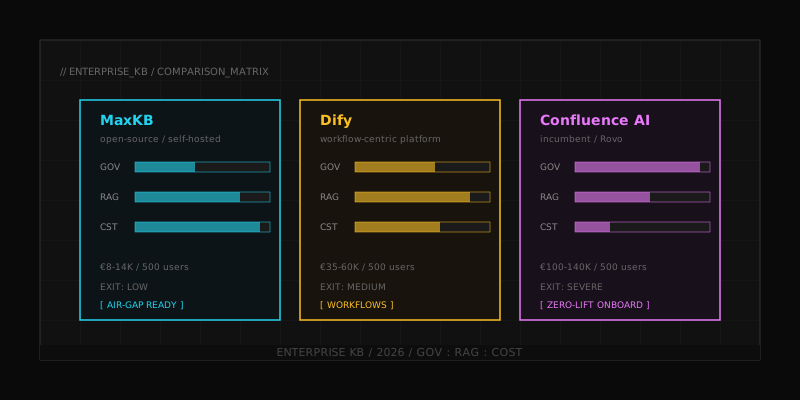
Three tools. Three completely different bets on what an enterprise knowledge base should be in 2026. Pick wrong and you are not just paying twice for the migration in 18 months. You are paying for a year of disappointed VPs, a burnt-out platform team, and a procurement cycle that you wanted to avoid in the first place.
MaxKB, Dify, and Confluence AI all answer the question "where does institutional knowledge live and how do LLMs reach it" — but they answer it from radically different starting points. MaxKB is the open source bet on portable RAG. Dify is the workflow-first bet on knowledge as one node in an orchestration graph. Confluence AI is the incumbent bet that the wiki you already have is the wiki you will keep. Below: where each one wins, where each one rots, and how to decide before you commit a multi-year contract or a platform team headcount.
What "AI Knowledge Base" Even Means in 2026
The term has stretched past breaking point. In 2024 an "AI knowledge base" usually meant a vector database stapled to an LLM with a chat box on top. In 2026 enterprises expect at least seven layers in the stack, and any tool that cannot do all seven gets demoted to "component" status during architectural review:
- Ingestion: connectors for SharePoint, Confluence, Notion, Google Drive, Slack, Linear, Jira, S3, Salesforce, Zendesk, and at least two custom REST sources.
- Chunking and embedding: document-type-aware splitting, multiple embedding models, semantic versus fixed-window with overlap controls.
- Retrieval: hybrid dense plus BM25, reranking (Cohere, Voyage, or a self-hosted cross-encoder), metadata filters that respect ACLs.
- Governance: row-level permissions inherited from source systems, audit trail, PII redaction, retention policies, regional data residency.
- Generation: model routing across providers, prompt versioning, structured output, tool calling.
- Evaluation: citation accuracy, hallucination scoring, golden sets, A/B prompt rollouts.
- Surfaces: chat UI, Slack/Teams bot, API, embedded widget, voice.
Cross-reference any vendor pitch against that list. If they handwave more than two layers, they are selling you a prototype and calling it a platform. The same trap applies to internal builds — see the breakdown in our AI knowledge base guide for the full architectural pattern.
MaxKB: Open Source Strengths and Gaps
MaxKB is the most credible open source contender that emerged from the 2024–2025 RAG cycle. It ships as a single Docker compose with PostgreSQL plus pgvector, a Vue admin UI, and adapters for OpenAI, Azure, Ollama, vLLM, and a dozen embedding models. The default chunker is paragraph-aware, the default retriever is hybrid, and the chat surface ships a citation panel that links back to source documents. As a starter kit, it is the most "drop in and demo on Friday" tool in this category.
Where it wins:
- Cost predictability. Self-hosted on a single c6i.2xlarge plus an embedding GPU, running cost lands around €380–€620/month for a 5M-token corpus serving 200 internal users.
- Model portability. Switch between Claude, GPT-5, Gemini 2.5, and a local Llama 4 in the same workspace without re-ingesting.
- Air-gapped deployment. Defense, healthcare, and EU public sector deployments pick MaxKB precisely because nothing has to leave the perimeter.
- Source-available licensing. Apache-style permissive license, no per-seat fee, no per-query meter.
Where it rots:
- Permission inheritance is shallow. Out of the box, MaxKB does not propagate row-level ACLs from SharePoint or Google Drive. You either dump everything to "all users" or you write a custom sync that respects source ACLs — which costs you roughly 4–6 weeks of platform engineering for the first connector.
- Evaluation is bring-your-own. There is no golden-set runner, no citation precision dashboard, no automated regression suite. If you want eval, you wire up Ragas or Phoenix yourself.
- Workflow primitives are thin. MaxKB does retrieval-augmented chat. It does not do multi-step agents, tool routing, or approval workflows. The moment knowledge needs to become an action, you are bolting on a second platform.
- Connector breadth. Native connectors cover the obvious five or six sources. Salesforce, Zendesk, ServiceNow, and most ticketing systems require custom ingestion pipelines.
The honest read: MaxKB is the right call for 80 percent of mid-market internal knowledge bots where the corpus is under 50M tokens, the user base is under 500, and the team is comfortable owning Postgres, embeddings, and a Python ingestion job. It is the wrong call when governance must mirror source-system permissions row-for-row, or when the knowledge base needs to fan out into agentic workflows.
Dify: Workflow-Centric KB Approach
Dify enters the comparison from a different angle. It is fundamentally an LLM application platform — a visual workflow builder where "knowledge retrieval" is one node type among twenty. You can build a Dify app where the knowledge base is the entire experience, but the platform shines when retrieval is a step inside a larger flow: classify the question, retrieve from three different corpora, call two tools, generate a structured answer, then post to Slack with an approval gate.
Where it wins:
- Composable knowledge. Each "dataset" in Dify is a first-class object with its own embedding model, chunking strategy, and retrieval config. A single workflow can mix four datasets with four different retrieval strategies.
- Workflow primitives are deep. Conditional branching, loops, tool calls, HTTP nodes, code execution, human-in-the-loop. Knowledge becomes a step in a real automation, not the terminus.
- Both deployment modes. Cloud SaaS at roughly $59/user/month for the Team plan, or self-hosted via Docker Compose with the same feature set. Most enterprises pilot on cloud, then migrate self-hosted at year two.
- Observability built in. Per-node latency, token cost per workflow run, retrieval recall scores. The kind of dashboarding you would otherwise wire up via LangSmith or Phoenix.
Where it rots:
- Permissions are workspace-level, not document-level. Dify can isolate datasets per workspace and per app, but it does not natively understand "user A can see these 47 documents and not these 12." If your access model is complex, you do permission filtering at the application layer before retrieval — extra work, extra latency.
- Connector story is improving but immature. The Dify Knowledge Pipeline added Notion, Confluence, and Firecrawl connectors in early 2026, but the breadth and reliability lag established ETL tools.
- Self-hosted operations cost is real. Dify on Kubernetes with the recommended Weaviate or Qdrant backend takes a competent platform engineer 2–3 weeks to harden for production, plus ongoing care for the worker queue and embedding cache.
- Vendor velocity. Major schema changes shipped in 2025 broke a non-trivial number of community workflows during upgrades. Pin versions and test migrations in staging — assume nothing.
Dify is the right call when knowledge retrieval is one of many primitives you need, and when the engineering org will own the workflow layer for the next three years. It is the wrong call when the actual requirement is "make the wiki searchable by chat" and nothing more — the workflow surface area becomes overhead you do not amortize. For the broader RAG context this fits into, see our RAG 2025 guide.
Confluence AI: Incumbent Advantage and Ceiling
Confluence AI (now branded inside Atlassian Intelligence and Rovo) is the path of least resistance for any org that already runs Confluence as its source of truth. The pitch is simple: your knowledge already lives here, your permissions already work, your users already log in. Turn on the AI add-on and the wiki gets a chat surface, summarization, and a "find for me" agent — without a separate platform.
Where it wins:
- Zero ingestion problem. The content is already in Confluence. No connectors, no nightly sync, no chunk strategy to debate. Atlassian indexes it for you.
- Permissions inherit perfectly. Space and page-level restrictions in Confluence are honored by retrieval. Rovo will not surface a page the requesting user could not open directly. This is the single hardest problem in self-hosted RAG, and Atlassian solves it for you by definition.
- Cross-product reach. Rovo agents pull from Confluence, Jira, Trello, and Bitbucket simultaneously. The answer "what is the status of the auth rewrite" can mix architecture docs, the open Jira epic, and recent commits — no separate integration work.
- Procurement frictionless. If you already have an Atlassian contract, the AI add-on is a checkbox. No new vendor, no new SOC 2 review.
Where it rots:
- Locked corpus. Knowledge that lives outside Confluence — Notion pages, SharePoint folders, customer transcripts, Linear tickets, S3 PDFs — is invisible. The "cross-source" story is Atlassian-product cross-source, not enterprise cross-source.
- Cost scales aggressively. Rovo pricing in 2026 lands at roughly $20 per user per month on top of existing Confluence seats. For a 2,000-seat enterprise, that is $480,000/year before you have measured a single retrieval quality metric.
- Model choice is gone. You get Atlassian's model selection, not yours. No Claude Opus for the legal team, no fine-tuned Llama for the security desk. One vendor, one routing decision.
- Eval and observability are shallow. Retrieval quality dashboards exist but are nowhere near the granularity of a Ragas-driven evaluation suite. You trust Atlassian's defaults or you do not measure.
- Exit cost is severe. Once two years of org behavior is conditioned on Rovo, ripping it out costs you the user behavior change in addition to the platform migration.
Decision Matrix: Scale, Governance, Control
The honest comparison across the dimensions that actually matter at procurement:
| Dimension | MaxKB | Dify | Confluence AI |
|---|---|---|---|
| Deployment model | Self-hosted | SaaS or self-hosted | SaaS only |
| Annual cost (500 users) | €8K–14K infra | €35K–60K seats + infra | €100K–140K seats |
| Connectors out of box | 6–8 native | 15+ native, expanding | Atlassian stack only |
| Row-level ACL inheritance | Custom build | App-layer filtering | Native, automatic |
| Workflow primitives | Minimal | Deep, visual | Rovo agents (limited) |
| Model portability | Any provider, any local | Any provider, any local | Vendor-controlled |
| Eval and observability | Bring-your-own | Built-in dashboards | Basic, opaque |
| Time to first answer | 2–5 days | 4–10 days | 2 hours |
| Exit cost | Low (your data, your DB) | Medium (workflow rebuild) | Severe (org lock-in) |
Use this matrix as a starting point, not a verdict. The "right" answer depends entirely on which dimensions are load-bearing for your org. A regulated bank weighs governance and audit at 5x the weight of cost. A 40-person startup weighs time-to-first-answer at 5x the weight of exit cost. Score honestly.
Quick Triage Heuristics
- If 80%+ of your knowledge already lives in Confluence and procurement is the slow part of the org — turn on Rovo, measure for 90 days, then revisit.
- If your corpus is fragmented across 6+ source systems and you have a platform team — MaxKB or Dify, depending on whether you need workflows.
- If retrieval is one step in a larger agentic flow — Dify, not MaxKB.
- If air-gapped or sovereign cloud is non-negotiable — MaxKB or self-hosted Dify, Confluence AI is out.
- If you have not defined an eval methodology yet — stop, do that first. Tool choice means nothing without a golden set. See our notes on enterprise AI deployment for the eval-first sequence.
Migration Paths and Exit-Cost Analysis
The decision people miss is not which tool wins on day one. It is which tool you can leave when the org changes direction in year three. Three scenarios are worth modeling before you commit.
Scenario A: Confluence AI → MaxKB
Why you would: cost pressure at scale, multi-source corpus requirement that Atlassian cannot satisfy, or a sovereign cloud mandate. The exit lift is moderate — Confluence has a clean export API, and MaxKB ingests Markdown directly. The hard part is reproducing permission inheritance. Budget 6–10 weeks of platform work to write a sync that maps Confluence space restrictions onto MaxKB document tags, plus a session-time filter that respects them. End-to-end migration cost for a 5,000-page corpus and 800 users: roughly €40K–80K in platform engineering plus 3 months of elapsed time.
Scenario B: MaxKB → Dify
Why you would: retrieval works, but the org needs to graduate to multi-step agents and approval workflows. Easiest of the three migrations. Both run on Postgres-plus-vector, both speak OpenAI-compatible APIs, both let you keep your embeddings. The data layer transfers cleanly. What you rebuild is the chat surface and any custom retrieval logic. Budget 2–4 weeks of engineering. The risk is feature creep — once Dify is in place, the temptation to wire every internal process through it is strong, and that is how you end up with a workflow platform you cannot maintain.
Scenario C: Dify → Confluence AI
Why you would: org consolidation onto Atlassian, or a strategic decision to reduce platform count. The hardest migration of the three because you are giving up the workflow layer entirely. Anything that was a Dify workflow becomes either a Rovo agent (limited scope) or a separate automation tool. Budget the rebuild at 2–4 months and expect to lose 20–30 percent of your workflow library to feature gaps. This is the migration that goes badly when teams treat it as a "like-for-like" swap.
Exit Cost Is the Real Cost
The pattern: tools with low day-one cost often have low exit cost (MaxKB), tools with medium day-one cost have medium exit cost (Dify), and tools with low day-one friction can have severe exit cost (Confluence AI). Run the three-year total cost of ownership including a forced migration in year three at 30 percent probability. That is the number that actually matters at procurement, not the sticker price on the order form.
Key Takeaways
- MaxKB wins on cost, portability, and air-gapped deployment — loses on ACL inheritance and workflow depth.
- Dify wins on workflow primitives and observability — loses on document-level permissions and operational overhead.
- Confluence AI wins on zero-friction onboarding and native permission inheritance — loses on cross-source reach and long-term cost.
- Eval methodology comes before tool choice. A golden set and a citation-accuracy metric matter more than the logo on the platform.
- Model the three-year TCO with a 30 percent forced-migration probability. That is the real procurement number.
- The wrong choice is not the wrong tool. It is choosing without scoring the dimensions that are load-bearing for your org.
Learn more: How it works · Why bundles beat raw thread history