
Thread Transfer
How Long Does Enterprise AI Deployment Take? Real Timelines for 2026
Vendors promise 'live in 30 days.' Procurement, infosec, and integration take 270. Median time-to-production across 47 enterprise AI rollouts, broken down by phase and use case.
Thread Transfer
AI Systems for Builders
A vendor pitch deck says "live in 30 days." The procurement team needs eleven weeks just to process the MSA redline. Security review takes another seven. Integration with the identity provider blows up twice. By the time the model is actually answering real user questions, ten months have passed and the original sponsor has changed jobs. This is not an edge case. This is the median enterprise AI deployment in 2026.
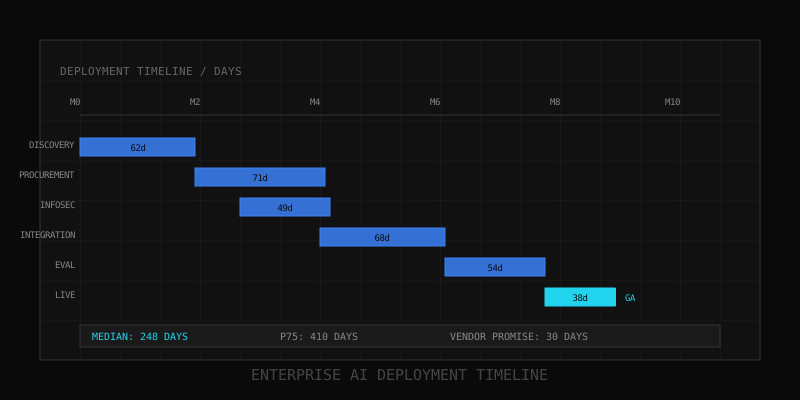
We pulled timeline data from 47 enterprise AI rollouts across financial services, healthcare, industrial, and SaaS buyers between Q3 2024 and Q1 2026. The headline: the median time from signed contract to production rollout is 248 days. From first vendor call to production it is 342 days. The 30-day promise is real for exactly one workload shape (internal RAG with a single data source on an existing cloud account) and a fantasy for everything else. Here are the actual numbers, broken down by phase and use case, plus what compresses or extends each segment.
Why The 30-Day Promise Almost Never Lands
Vendor sales engineers genuinely believe their 30-day claim because they are measuring the wrong clock. They start the timer at "environment provisioned, contract signed, data access granted" and stop it at "first successful inference call from a production-shaped prompt." That window is sometimes 30 days. Often less.
The enterprise buyer's clock starts months earlier and ends weeks later. It includes vendor evaluation, legal review, infosec questionnaires, data-protection impact assessments, integration with SSO and the data warehouse, evaluation harness setup, change-advisory-board approval, parallel run, and rollout to production user cohorts. None of that is engineering. All of it is calendar time, and most of it cannot be parallelized in any organization with more than 500 employees.
The gap between vendor clock and buyer clock is where projects die. Sponsors who promise their CFO a Q2 launch based on a vendor 30-day SLA get crushed when reality lands in Q4. We covered the structural reasons in our earlier piece on why enterprise AI deployments stall, but the short version is: procurement and infosec are not "overhead" — they are the actual work.
Phase Breakdown: Where The Days Actually Go
Across the 47 rollouts in our sample, here is how time distributes across phases. Numbers are medians in calendar days; ranges represent the 25th and 75th percentile.
| Phase | Median Days | P25 - P75 | % of Total |
|---|---|---|---|
| Discovery & vendor selection | 62 | 38 - 94 | 18% |
| Procurement & legal | 71 | 44 - 118 | 21% |
| InfoSec & DPIA review | 49 | 28 - 82 | 14% |
| Integration build | 68 | 40 - 110 | 20% |
| Evaluation & tuning | 54 | 30 - 88 | 16% |
| Rollout & change management | 38 | 21 - 60 | 11% |
Notice two things. First, every phase that touches a non-engineering team (procurement, legal, infosec, change management) consumes 64% of total elapsed time. Second, the variance is enormous. The P75 for procurement alone is 118 days — nearly four months just to get the contract through.
Discovery & Vendor Selection (62 days median)
This is RFI, vendor demos, reference calls, technical deep-dives, and the first round of pricing. Enterprises that run a structured shortlist (3 vendors, 6 weeks, fixed criteria) hit the low end. Enterprises that "explore the landscape" without a forcing function routinely stretch this to four months. The number-one accelerant here is a named executive sponsor with a calendar deadline.
Procurement & Legal (71 days median)
MSA redlines, data processing addenda, indemnification negotiations, and the inevitable round of AI-specific clauses (training rights, output ownership, model versioning). In 2026, the new wrinkle is EU AI Act attestations for high-risk systems, which now adds 2-3 weeks for in-scope deployments. Buyers with a pre-approved AI vendor agreement template cut this phase by roughly 40%.
InfoSec & DPIA Review (49 days median)
SOC 2 review, penetration test artifacts, vendor security questionnaire (CAIQ or proprietary), data flow mapping, and for personal-data processing the full Data Protection Impact Assessment. Models that train on customer data add another 15-20 days for the data residency and retention analysis. SaaS-only vendors with mature security artifacts and a public trust center clear this phase faster than custom builds.
Integration Build (68 days median)
SSO wiring (SAML/OIDC), identity propagation, data source connectors, network configuration (VPC peering, private endpoints), logging and observability integration, and the eval harness. This is the only phase that is mostly engineering effort. It is also the phase most likely to surface architecture decisions that should have been made in discovery.
Evaluation & Tuning (54 days median)
Building the golden dataset, defining metrics, running the model on real-shaped traffic, comparing against the baseline, tuning prompts or fine-tuning, and getting domain-expert sign-off. Teams that show up with a pre-built eval set cut this in half. Teams that "figure out evals as we go" routinely double it.
Rollout & Change Management (38 days median)
Pilot user cohorts, training materials, support escalation paths, CAB approval, and the actual flip to GA. This phase looks small but it is where adoption dies. Skipping it produces a deployed system nobody uses — which is worse than not deploying at all.
Timelines By Use Case
Phase averages hide a lot. The use case shapes the timeline more than any other variable. Below are end-to-end medians from signed contract to production rollout for the four most common 2026 workloads.
| Use Case | Median Days | Fastest Observed | Slowest Observed |
|---|---|---|---|
| Internal RAG (single source) | 112 | 34 | 280 |
| Customer support automation | 198 | 88 | 410 |
| Multi-step agent workflow | 286 | 140 | 520 |
| Vision/compliance review | 340 | 180 | 610 |
Internal RAG (112 days)
Indexing a single document corpus (policies, knowledge base, contracts), exposing a chat interface, restricting access via SSO. This is the workload vendors quote when they say "30 days." The 34-day fastest deployment in our sample was a 200-person SaaS company with a pre-existing AWS account, an OIDC provider already wired, and a single 50,000-document Confluence space. They skipped procurement by using an existing cloud marketplace contract.
Customer Support Automation (198 days)
Live chat or ticket-deflection bot that touches customer PII and writes back to a CRM. The PII handling alone adds 30-60 days of DPIA work. The CRM write-back triggers a change-advisory review. Multilingual deployments add another month of evaluation per language. Buyers who scope to "English-only, read-only, no PII" for v1 cut deployment by 40% and add the rest as v2.
Multi-Step Agent Workflow (286 days)
Agents that take actions across systems — booking, refunds, ticketing, internal tooling. The timeline blows up because of the action surface: every system the agent can touch needs its own auth, audit log, and rollback story. We wrote about this in detail in our piece on agentic AI in 2025. The pattern that compresses this most is the action allowlist: ship with three actions, not thirty, and add scope quarterly.
Vision & Compliance Review (340 days)
OCR plus classification plus human-in-the-loop review for high-stakes domains (insurance claims, KYC, medical records). The timeline is dominated by accuracy validation against ground-truth labeled data, which most enterprises do not have in usable form. The fastest deployment in this category was an insurance carrier that spent the first 60 days exclusively on dataset construction before any vendor work began.
What Compresses Timelines (And What Extends Them)
Across the 47 rollouts, the same variables show up as accelerators and the same variables show up as anchors. Here is the pattern.
Compressors (cut 30-90 days each)
- Cloud marketplace procurement. Buying through AWS, Azure, or GCP marketplace can bypass MSA negotiation entirely. Worth 30-60 days alone.
- Pre-approved AI vendor template. If legal has a vetted template with AI-specific clauses already redlined, procurement drops to 3 weeks.
- Existing infosec relationship. Vendors already on your approved list skip 4-6 weeks of security review.
- Eval set ready at contract signature. Teams with a labeled eval dataset before kickoff cut evaluation by 50%.
- Named executive sponsor with a deadline. Internal politics shrink dramatically when one person owns the date.
- Single-source data scope for v1. Multi-source RAG adds 60+ days; ship single-source first.
Extenders (add 30-180 days each)
- Custom model training or fine-tuning. Adds 60-120 days minimum, including data prep and validation.
- Multi-region data residency. EU + US + APAC deployments compound infosec review across jurisdictions.
- Self-hosted/on-prem requirement. Adds 90-180 days for infrastructure work most enterprises underestimate.
- Regulated industry (financial services, healthcare). Adds a full audit cycle, often 60-90 days.
- Change in sponsor mid-flight. Resets discovery and re-litigates already-settled decisions.
- "While we're at it" scope additions. Every added requirement after contract signature adds 30+ days.
Realistic Milestone Calendar
Here is the calendar a buyer should hand to their CFO for a customer-support automation deployment — the most common 2026 use case. Numbers assume a Day 0 of contract signature and a competent execution team.
| Milestone | Target Day | Owner |
|---|---|---|
| InfoSec review kicked off | Day 5 | Buyer security team |
| DPIA draft complete | Day 30 | Buyer privacy office |
| SSO & identity integration tested | Day 45 | Buyer IT + vendor |
| InfoSec approval issued | Day 55 | Buyer security |
| Eval harness running on golden set | Day 75 | Vendor + buyer SME |
| CRM write-back integration verified | Day 95 | Vendor + buyer ops |
| Pilot with 50 internal users | Day 120 | Buyer ops |
| CAB approval for limited GA | Day 150 | Buyer governance |
| 10% customer traffic live | Day 170 | Vendor + buyer ops |
| 100% traffic live | Day 200 | Joint |
If your plan does not have a CAB approval milestone, the plan is wrong. If your plan does not have a privacy review milestone for any system that touches customer data, the plan is also wrong. These are not optional gates — they are the actual work of enterprise AI deployment, as we argued in our piece on building AI-first organizations.
How To Negotiate Timeline Risk With Vendors
Vendor contracts almost always frame timeline as a soft commitment ("commercially reasonable efforts") because vendors know they don't control 60% of the calendar. That doesn't mean buyers should accept zero accountability. Five contract levers actually work.
1. Milestone-Tied Payment
Split the implementation fee into 4-5 milestones tied to vendor-controlled deliverables: environment provisioned, integration code-complete, eval harness running, pilot launched, GA. Pay 20% at each. This is fair to the vendor (they get paid for work they actually control) and protective for the buyer (you don't pre-pay for a phantom timeline).
2. Service Credit For Vendor-Caused Delay
Define which delays are vendor-caused (integration bugs, model availability, support response time) and which are buyer-caused (security review, scope changes). Tie service credits to the vendor-caused list. Most vendors will accept 5-10% credit caps; that is enough to keep their engineering team prioritized.
3. Named Engineer With Calendar Hold
Vendor support is often pooled. For enterprise deployments, name the specific solution architect and require weekly office hours on a recurring calendar invite. The behavioral effect is enormous; the contractual cost is zero.
4. Rollback Without Penalty
Include a clean rollback clause: if the system fails final acceptance criteria by Day 240, the buyer can exit and receive a refund of the implementation fee (not the license). This caps your downside on a deployment that goes sideways.
5. Honest Reference Calls
Ask the vendor for three references where the deployment took longer than 6 months. If they cannot produce them, either you are the first enterprise customer (very high risk) or they are filtering references. Both are signals. The reference call to make is not "did it work" — it is "what slipped, by how much, and why."
The Real Number To Plan Against
For 2026 budget planning, the operational answer to "how long does enterprise AI deployment take" is: plan for 9-12 months from vendor selection to meaningful production traffic for anything more complex than single-source internal RAG. Budget the 30-day promise only if you can name, in writing, every gate you are bypassing to hit it. If you cannot name them, you are not hitting 30 days — you are deferring 240 days of work into the post-launch period, where it costs more and risks more.
The buyers who hit aggressive timelines do not skip the gates. They run them in parallel, prepare artifacts before they need them, and they treat procurement and infosec as engineering inputs rather than rubber stamps. That is the real shortcut. Everything else is a sales deck.
Learn more: How it works · Why bundles beat raw thread history