
Thread Transfer
Data Processing Agreement Generator: What a Real DPA Must Contain in 2026
Most DPA generators give you a 2018 template that pretends AI sub-processors don't exist. Here's what a defensible 2026 DPA actually contains.
Thread Transfer
AI Systems for Builders
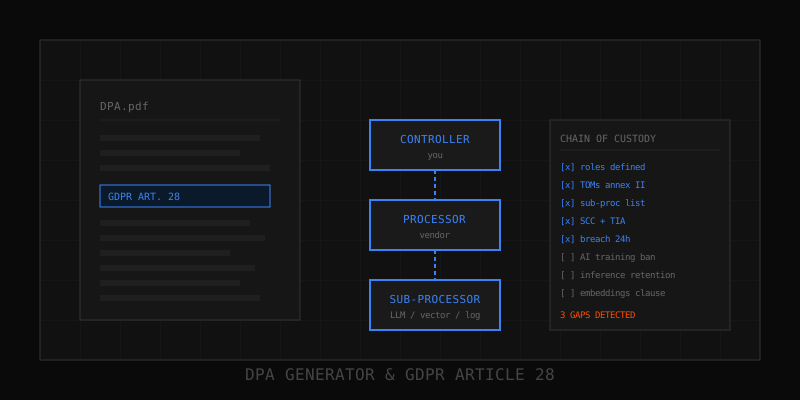
Most data processing agreement generators online are running on a template that was written in 2018, lightly edited in 2021, and has not been touched since. They pretend that Schrems II never happened, that the EU-US Data Privacy Framework is optional flavor, and most dangerously, that AI sub-processors do not exist. In 2026 that template is not a contract. It is a fine waiting to be issued.
A DPA is the binding contract between a data controller (you, the SaaS, the agency, the platform) and a data processor (your vendor, your model provider, your hosting layer). Article 28 of the GDPR makes it mandatory. Skip it and you are exposed to administrative fines up to 4% of global annual turnover, civil claims from data subjects, and a regulator who is far less patient than they were five years ago. This piece walks through what a real DPA must contain in 2026, what the generators leave out, and how to customize a template without creating a liability landmine.
What GDPR Article 28 Actually Requires
Article 28 is short. It is also non-negotiable. The processor must only act on documented instructions from the controller. The contract must be in writing. And it must set out the subject matter, duration, nature, purpose of processing, the type of personal data, the categories of data subjects, and the obligations and rights of the controller. That is the floor. Everything else is structural reinforcement around that floor.
Where most generators fail is not in the bullet points they include. It is in the bullet points they treat as boilerplate. Documented instructions is not a recital. It is a continuous obligation. If your processor uses your customer data to train a model, fine-tune embeddings, or improve a recommendation engine and you did not document that instruction, you are in breach. The processor is in breach. Both of you can be fined separately under Article 83.
| Article 28 Requirement | What It Means In Practice | Generator Coverage |
|---|---|---|
| Documented instructions | Every processing activity scoped in writing | Usually generic single clause |
| Confidentiality of personnel | Named obligation, enforceable downstream | Present but unverifiable |
| Article 32 security measures | Specific technical and organizational measures (TOMs) | Often a placeholder annex |
| Sub-processor authorization | Prior specific or general written authorization | Vague — no AI vendor list |
| Assistance with data subject rights | Mechanism + timelines for access, erasure, portability | Usually present, rarely tested |
| Breach notification | Without undue delay (typically 24-72h) | Inconsistent timelines |
| Audit rights | Right to inspect or commission audits | Often watered down to SOC 2 review |
| Return or deletion at end | Controller choice, certified destruction | Frequently silent on certification |
If your generator output covers fewer than seven of those eight in concrete language, you do not have a DPA. You have a memo that uses the word DPA.
Mandatory Clauses Every DPA Must Contain
Stripped of the legal aesthetic, here is what cannot be missing. Treat this as the minimum viable contract. Anything beyond is negotiation. Anything below is exposure.
1. Defined Roles And Scope
Name the controller. Name the processor. Name any joint controllers explicitly because Article 26 has its own rules and you do not want to discover mid-incident that your vendor is actually a joint controller. Define the subject matter (what processing), nature (how), purpose (why), and duration (how long). A line like "for the provision of the services" is not a scope. It is a vibe.
2. Categories Of Data And Data Subjects
Spell out the data types. Special category data under Article 9 (health, biometric, political, sexual orientation, religious) requires elevated handling and explicit acknowledgment. If your vendor processes chat transcripts, you almost certainly have special category data slipping in. Customer support logs are full of it. Generators that lump everything into "contact details and usage data" are misrepresenting the risk surface.
3. Technical And Organizational Measures (Annex II)
TOMs cannot be a sentence. They are an annex. Encryption at rest and in transit, pseudonymization where applicable, access control with named role boundaries, logging retention windows, backup frequency and geography, incident response SLAs, and personnel training cadence. If a regulator opens a file, this annex is the first thing they read. A blank or generic Annex II is the most common reason supervisory authorities escalate.
4. Sub-Processor List With Geography
Maintain a current, dated list. For each sub-processor: legal name, processing activity, geographic location of processing (not just headquarters), and applicable transfer mechanism. The list must be reachable by the controller without a support ticket. Most generators output "list available on request," which means the list does not exist.
5. Cross-Border Transfer Mechanism
Standard Contractual Clauses (the 2021 modules) for non-DPF transfers. DPF certification reference for US-recipient transfers where applicable. UK Addendum for UK data. Swiss FDPIC requirements where Swiss data is involved. We will go deeper in a moment, but if this clause is not in the DPA, the DPA is unfit for any non-EEA processor.
6. Breach Notification Mechanics
Article 33 gives the controller 72 hours to notify the regulator. Your processor must therefore tell you in substantially less time. The market norm is 24 hours from confirmed incident, with a preliminary notification within 12 hours of detection. Anything looser is the processor protecting themselves at your expense.
7. Audit And Inspection Rights
The controller has a right to audit. Practically this is reconciled through pre-existing third-party reports (SOC 2 Type II, ISO 27001, ISO 27701) plus a contractual right to commission an on-site audit at the controller's cost with reasonable notice. If the contract removes the on-site right entirely, that is a red flag.
8. Return And Deletion Terms
On termination, controller chooses return or deletion. Deletion certificate within 30 days. Backup retention windows disclosed. Legal hold exceptions explicitly listed. This is where AI vendors get sloppy because model weights derived from your data do not delete cleanly. The contract has to acknowledge that.
AI Sub-Processors And The New Chain-Of-Custody Problem
Here is where 2018 templates fall apart. A modern SaaS stack looks like this: your application talks to a primary LLM provider, which routes through a hosting platform, which uses a vector database, which has its own embedding model, which writes telemetry to a third logging vendor. That is five data flows. Each one is a potential sub-processor. Each one needs audit-ready handling.
The new chain-of-custody problem is that personal data inside an LLM prompt does not behave like personal data inside a SQL row. It can be cached, used for safety classification, retained for abuse review, surfaced in evaluations, or quietly fine-tuned into a derived model. Each of those is a distinct processing purpose under Article 6. A DPA that does not address them is silent on most of what is actually happening.
What A 2026 DPA Must Cover For AI Vendors
- Training data exclusion clause: Explicit prohibition on using controller data to train, fine-tune, or improve foundation models. Most enterprise LLM tiers offer this. Free and standard tiers frequently do not. Verify the actual API endpoint configuration matches the contract.
- Inference retention window: Maximum number of days the provider retains prompts and completions for abuse monitoring. Industry default sits between 0 and 30 days. Demand the lower end for sensitive workloads.
- Human review carve-outs: If the provider performs human review of flagged content, who are those humans, where do they sit, and what is the data minimization protocol? This is the clause that almost never appears in generator output.
- Sub-model disclosure: Many LLM providers route to multiple underlying models. The DPA must require disclosure of which models touched the data, or at minimum a binding policy on routing geography.
- Vector store and embedding handling: Embeddings derived from personal data are still personal data under recital 26. A DPA that treats them as anonymous is wrong. Treat them as identifiable.
- Model card and impact disclosure: Tie this to the EU AI Act obligations if the deployment crosses any high-risk threshold. The DPA is the practical anchor for AI Act compliance evidence.
A useful heuristic: if your DPA does not mention training, inference, retention, or embeddings anywhere, it was written for a world that no longer exists.
Cross-Border Transfer Mechanisms Post-DPF
The EU-US Data Privacy Framework took effect July 10, 2023 and has survived its first round of legal scrutiny, but it is fragile. Treat it as conditional infrastructure. Your DPA must work whether or not the DPF is alive on the date the regulator opens the file.
| Recipient Location | Primary Mechanism | Fallback If Mechanism Fails |
|---|---|---|
| EEA | None required | N/A |
| United States (DPF certified) | DPF certification reference | SCCs Module 2 or 3 + TIA |
| United States (non-DPF) | SCCs Module 2 or 3 + TIA | Supplementary measures |
| United Kingdom | UK Addendum to SCCs | IDTA standalone |
| Adequacy country (CH, CA, JP, KR, NZ, IL, UY, AR) | Adequacy decision reference | SCCs as belt-and-braces |
| Everywhere else | SCCs + Transfer Impact Assessment | Supplementary measures or stop |
Most generators stop at "SCCs apply." That is not enough. The DPA must reference the specific Module (2 for controller-to-processor, 3 for processor-to-processor), and the annex must include the Transfer Impact Assessment summary. The TIA is the document the regulator asks for after Schrems II. If you cannot produce it, the SCC reference is decorative.
Red Flags In Popular DPA Generators
Having reviewed output from roughly a dozen of the most-cited DPA generators on Google, here are the patterns that recur. If any of these appear in your generated DPA, fix them before signing.
- "Processor may engage sub-processors as needed." This is general authorization without notice obligation. Article 28(2) requires the controller be informed of changes and given a chance to object. Add the notice window (30 days is standard) and an objection mechanism.
- Annex II says "industry-standard security measures." That phrase is regulator catnip. It means nothing. Replace it with the actual measures.
- Breach notification "without undue delay." Article 33 language is fine for the controller- to-regulator hop. For the processor-to-controller hop you need a hard number. 24 hours is the operating norm.
- No reference to AI training or model improvement. If the vendor uses AI anywhere in the processing chain (and they do), this silence is a defect.
- DPF mentioned but no SCC fallback. Single-mechanism dependency on the DPF is one CJEU ruling away from a compliance gap. Layer the SCCs underneath.
- Audit right limited to "reasonable request, no more than once per year, at processor's discretion." That last phrase is a violation of Article 28(3)(h). Strike it.
- Liability cap below the GDPR fine exposure. A 12-month-fees cap on processor liability is industry norm but is grossly inadequate against a 4%-of-turnover fine. Negotiate a carve-out for data protection breaches.
- Governing law set to a non-EU jurisdiction. Acceptable for commercial terms. Not acceptable for the DPA itself if EEA data subjects are involved. The DPA should sit under an EU member state law.
A DPA Template And How To Customize It Safely
The structure below is the skeleton used in production by privacy-mature SaaS companies. Use it as a starting point, not a finishing point. A DPA is only as strong as the annexes attached to it. For more on the broader regulatory context driving these requirements, see our overview of the AI regulatory landscape.
Body Sections (Negotiate Carefully)
- Definitions (align with GDPR Article 4 verbatim, do not paraphrase)
- Subject matter, nature, purpose, duration of processing
- Roles and processing instructions
- Confidentiality obligations
- Security of processing (refers to Annex II)
- Sub-processors (refers to Annex III, plus notice and objection)
- Data subject rights assistance
- Personal data breach notification
- Data Protection Impact Assessment cooperation
- Cross-border transfers (refers to Annex IV)
- Audit and inspection
- Return or deletion on termination
- Liability and indemnity (negotiate the carve-out)
- Governing law and venue
Annexes (This Is Where DPAs Live Or Die)
- Annex I: Processing details. Data subjects, data categories, processing operations, retention.
- Annex II: Technical and organizational measures. Concrete. Auditable.
- Annex III: Sub-processor list. Current as of signing date. Update mechanism.
- Annex IV: SCCs and supplementary measures, with TIA summary.
- Annex V (recommended): AI processing addendum. Training prohibition, inference retention, model disclosure.
Customization Checklist
- Pull a current sub-processor list from the vendor and reconcile it against your tech stack diagram. Mismatches are red flags.
- Verify Annex II TOMs against a current SOC 2 or ISO 27001 report. Anything in the DPA that is not in the report is theater.
- Run the breach notification timeline as a tabletop exercise. If the processor cannot meet 24 hours operationally, the contract clause is fiction.
- Confirm the transfer mechanism is layered (primary plus fallback). Single-mechanism DPAs age badly.
- For any AI vendor, add Annex V or fold the equivalent language into Annex I. Do not let the AI question go unanswered.
- Set a calendar review every 12 months. Sub-processor lists, TOMs, and transfer mechanisms drift. The DPA has to drift with them.
The Brutal Summary
A DPA generator can give you a starting draft. It cannot give you a defensible contract. The defense lives in the annexes, in the AI-specific clauses that most generators omit, and in the transfer mechanism stack that does not collapse the next time a court rules on adequacy. If your current DPA was generated by a tool, exported to PDF, and filed away, it is most likely incomplete in at least three of the eight Article 28 requirements. Run it back through the checklist above before the next renewal cycle, not after the next breach.
The fine math is unforgiving. A mid-size SaaS doing €5M ARR with a sloppy DPA, a sub-processor leak, and no TIA on file is staring at a theoretical €200K administrative fine ceiling, plus civil exposure, plus the operational hit of regulator engagement. The cost of doing the DPA properly is one focused afternoon and a modest legal review. The asymmetry is not subtle.
Learn more: How it works · Why bundles beat raw thread history