
Thread Transfer
Cost Cap vs Bid Cap vs Lowest Cost: Meta Ads Bidding Strategies Decoded
Bid cap and cost cap sound interchangeable until your CPA doubles overnight. The math, the decision tree, and the mistakes that cap your scale.
Thread Transfer
AI Systems for Builders
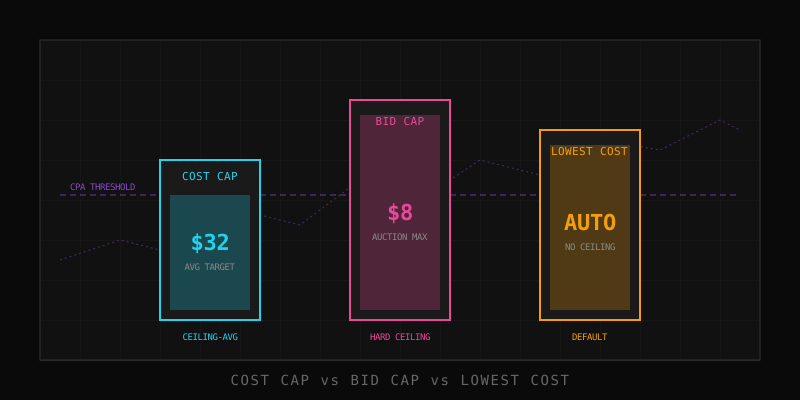
Bid cap and cost cap sound interchangeable until your CPA doubles overnight. We've watched advertisers flip from Lowest Cost to Bid Cap thinking they're "getting more control," only to wake up to a CPA chart that looks like a heart-rate monitor mid-cardiac event. The difference is buried in a tooltip Meta hides behind a question-mark icon, and it's the single most expensive misunderstanding in paid social.
Meta gives you five real bid strategies — Lowest Cost, Cost Cap, Bid Cap, Target Cost (now deprecated for most objectives), and ROAS Floor (the value-based cousin of Cost Cap). Most accounts never move off the default. The ones that do usually pick wrong because Meta's own documentation explains the math like a tax form. This post is the version we wish we'd had when we lit $3,200 on fire learning the difference.
Cost Cap Meaning In Plain English
Cost Cap tells Meta: "Get me as many conversions as possible, but keep my average CPA at or below this number." The word that matters is average. Meta is allowed to pay $45 for one conversion if it also gets a $15 conversion later — as long as the rolling average lands at or below your cap.
Think of it as a budget governor with a leash. Meta is still optimizing for volume, but the leash gets shorter the further your blended CPA drifts above the cap. When you set Cost Cap at $25, you're not saying "never pay more than $25 per result." You're saying "average out to $25 or I'll throttle you."
Here's a real seven-day window from one of our e-commerce accounts running Cost Cap at $32:
| Day | Spend | Conversions | Daily CPA | Rolling Avg |
|---|---|---|---|---|
| Mon | $240 | 9 | $26.67 | $26.67 |
| Tue | $280 | 7 | $40.00 | $32.50 |
| Wed | $260 | 8 | $32.50 | $32.50 |
| Thu | $220 | 10 | $22.00 | $29.41 |
| Fri | $300 | 8 | $37.50 | $31.06 |
| Sat | $310 | 9 | $34.44 | $31.65 |
| Sun | $240 | 8 | $30.00 | $31.42 |
The daily CPA bounces between $22 and $40 — Tuesday alone was 25% above the cap — but the rolling average stayed within striking distance of $32. That's Cost Cap doing its job. If your boss screenshots Tuesday and panics, that's a process problem, not a bidding problem.
Bid Cap Meaning And The Math Behind The Auction
Bid Cap is fundamentally different. It does not care about your CPA. Bid Cap sets a ceiling on what Meta will offer in the second-price auction for a single impression. If you set Bid Cap at $8, Meta will never enter the auction with a bid above $8 — even if winning that auction would still produce a profitable conversion.
The math: Meta's auction is decided by Total Value = Advertiser Bid × Estimated Action Rate + Quality Score. With Lowest Cost or Cost Cap, Meta calculates the bid internally based on what it predicts you can afford. With Bid Cap, you're manually setting the bid component yourself. You are now playing media buyer the same way someone running Google Ads in 2012 was — except Meta's machine learning models are tuned for the assumption that you're not doing this.
Practical translation: Bid Cap usually underdelivers. We see Bid Cap ad sets sit at 30-60% delivery vs. their daily budget because the cap is too low to win meaningful auctions. The advertiser sees cheap impressions and pats themselves on the back, but the impressions are the dregs Meta couldn't sell to anyone else.
Quick comparison of how the two caps behave in the same auction:
| Scenario | Cost Cap ($25 target) | Bid Cap ($25 ceiling) |
|---|---|---|
| High-intent user, predicted CVR 4% | Bids ~$1.00 CPM-equivalent, wins | Bids up to $25 if needed, wins easily |
| Low-intent user, predicted CVR 0.2% | Skips auction (would blow cap) | Bids up to $25, often wins, wastes money |
| Competitive vertical, CPM spike | Pauses delivery, waits for cheaper window | Hits ceiling, underdelivers, misses scale |
Lowest Cost vs Target CPA: The Silent Default
Lowest Cost is Meta's default and the bid strategy 90% of accounts run on. It's the simplest instruction: "Spend my entire daily budget. Get as many results as possible. I don't care what each one costs."
Lowest Cost is excellent when you're still discovering what your account can do. It lets Meta find the cheapest pockets of conversion. The downside is exactly what its name implies — no ceiling. If your CPA drifts from $22 to $48 over four weeks because of audience saturation or seasonality, Lowest Cost will happily keep spending. It has no opinion about whether you're still profitable.
Target CPA is now hidden inside Cost Cap for most objectives, but the legacy "Target Cost" behavior was different: it tried to keep CPA at your target, not just below it. That meant overpaying on cheap conversions to maintain a stable average. Meta deprecated it because nobody actually wanted that. Cost Cap is the modern replacement for advertisers who want a ceiling without a floor. For deeper context on how these strategies stacked up historically, our earlier breakdown at bid strategies compared walks through the side-by-side performance of all five.
When Each Bidding Strategy Actually Wins
Use this decision tree. Read it twice before you change a single ad set.
- Do you have at least 50 conversions in the last 7 days at the ad-set level? If no — stay on Lowest Cost. Period. Cost Cap and Bid Cap both starve without conversion volume to learn from. You'll hit underdelivery within 48 hours.
- Is your current CPA stable within ±15% week-over-week? If no — stay on Lowest Cost while you diagnose the volatility (creative fatigue, audience overlap, attribution shift). Layering Cost Cap on top of a thrashing CPA just hides the symptom.
- Is there a hard CPA number above which the account becomes unprofitable? If yes — Cost Cap, set 10-15% above your current 30-day average. Our detailed implementation walkthrough is in the cost cap bidding guide.
- Are you running brand or reach campaigns with predictable CPM ceilings you've verified?If yes — Bid Cap is a legitimate tool here. You're buying impressions, not conversions, so the auction math is simpler. Reference: bid cap strategy.
- Are you doing pure scale on a proven offer? Lowest Cost with a large daily budget will almost always outperform Cost Cap once you're past 200+ daily conversions. Cost Cap throttles you exactly when you'd want gas.
Notice what's missing from that tree: "I want to feel in control." Bid Cap is not a control mechanism. It's a delivery limiter. If you're reaching for it because Lowest Cost CPAs look scary, the answer is creative testing or audience refinement, not a bid strategy change.
How Bid Strategy Interacts With Learning Phase
Every time you change bid strategy, Meta restarts the learning phase. That's 50 conversions of CPA volatility at minimum, and often more if your conversion event is far down the funnel. We've seen accounts eat a $1,800 learning-phase tax in a single week by flip-flopping between Lowest Cost and Cost Cap based on gut.
The interactions worth knowing:
- Cost Cap + new ad set: Brutal combo. Meta has no conversion history to estimate auction probability, so it bids conservatively, conversions trickle, and you exit learning phase 2-3x slower than Lowest Cost would have. Always launch new ad sets on Lowest Cost, then graduate to Cost Cap after exit.
- Bid Cap + CBO (Advantage Campaign Budget): Don't. CBO needs flexibility to reallocate spend. Bid Cap removes that flexibility at the ad-set level, leading to chaotic and unpredictable budget flows.
- Cost Cap + significant cap change (>20%): Triggers re-learning. A small nudge (5-10%) is often absorbed without resetting, especially if conversion volume is high. Big swings get punished.
- Lowest Cost + budget changes: Doubling daily budget on a Lowest Cost ad set often reopens learning. Increase in 20% increments every 4-7 days for stability.
For the auction-side mechanics behind why learning phase exists at all, our piece on auction dynamics explained covers the second-price math and signal decay in detail.
Common Bid-Strategy Mistakes That Cap Your Scale
We audit 30-40 Meta accounts per quarter. The same five mistakes appear in roughly 70% of them. If you're running anything other than Lowest Cost, check this list first.
1. Setting Cost Cap At Your Goal CPA Instead Of Your Current CPA
Your current CPA is $38. Your CFO wants $25. So you set Cost Cap at $25. Underdelivery in 24 hours.Cost Cap can't magically conjure cheaper conversions — it can only honor what the auction makes possible. Set the cap 10-15% above current CPA, let Meta optimize toward it, then ratchet down 5% at a time once delivery stays full.
2. Using Bid Cap Without Knowing Your Average CPM
If your account's typical CPM is $18 and you set Bid Cap at $15, you're telling Meta to enter auctions with a bid lower than market clearing price. You won't win the impressions you need to scale. Bid Cap should sit at roughly 1.5-2x your average winning CPM if you're actually trying to deliver.
3. Changing Bid Strategy Mid-Test
Running a creative test on Lowest Cost, then flipping the winner to Cost Cap before scaling. Now you don't know if the CPA shift is from the bid change or the scale. Hold all non-test variables constant. Cost Cap can come later, after you've banked the creative learning.
4. Confusing Bid Cap With "Maximum CPA"
We've had three clients in the last year set Bid Cap at their max acceptable CPA, expecting that to cap their cost per result. It doesn't. Bid Cap caps auction bid, not conversion cost. A $25 Bid Cap can still produce $80 conversions if conversion rates are poor. If you want a CPA ceiling, you want Cost Cap.
5. Running Cost Cap On Low-Volume Conversion Events
Cost Cap needs signal. If your conversion event fires fewer than 50 times per week per ad set, Meta's cost estimates are essentially noise. The algorithm will either under-deliver (too cautious) or over-spend in bursts (over-correcting on stale data). Either optimize for a higher-volume mid-funnel event and use value rules, or stay on Lowest Cost until volume justifies the move.
The Honest Recommendation
For 80% of accounts under $50K/month in Meta spend, the right answer is: Lowest Cost on every ad set, and put your effort into creative refresh cycles and audience segmentation instead. Bid strategy tuning is the last 10% of performance. Creative is the first 60%. Spending three afternoons A/B testing Cost Cap thresholds while running stale creative is the most common form of fake-work we see in performance marketing.
Cost Cap earns its place when (a) you've hit a profitability ceiling and need a hard guardrail, and (b) you have the conversion volume to feed it. Bid Cap earns its place in reach/brand campaigns and almost nowhere else. Lowest Cost wins by default because Meta's ML stack is built around it.
Before you touch the bid strategy dropdown again, ask yourself: What is the bid strategy compensating for?If the answer is "weak creative" or "saturated audience," close the dropdown and go fix that instead. Bid strategy is a lever, not a fix.
Key Takeaways
- Cost Cap targets average CPA — individual conversions can exceed the cap
- Bid Cap sets a ceiling on auction bids, not on CPA — they are not interchangeable
- Lowest Cost is the right default for accounts under 50 weekly conversions per ad set
- Switching bid strategy resets learning phase — budget for a 7-day CPA spike
- Set Cost Cap 10-15% above current CPA, not at your goal CPA
- Bid Cap belongs in reach/brand objectives, almost never in conversion campaigns
- Creative and audience fix CPA problems faster than bid strategy ever will
Learn more: How it works · Why bundles beat raw thread history