
Thread Transfer
AI Governance Frameworks Compared: NIST AI RMF, ISO 42001, EU AI Act, and More
Five frameworks, three regulators, one decision. The layered stack that satisfies auditors, procurement, and the EU AI Act without duplicating work.
Thread Transfer
AI Systems for Builders
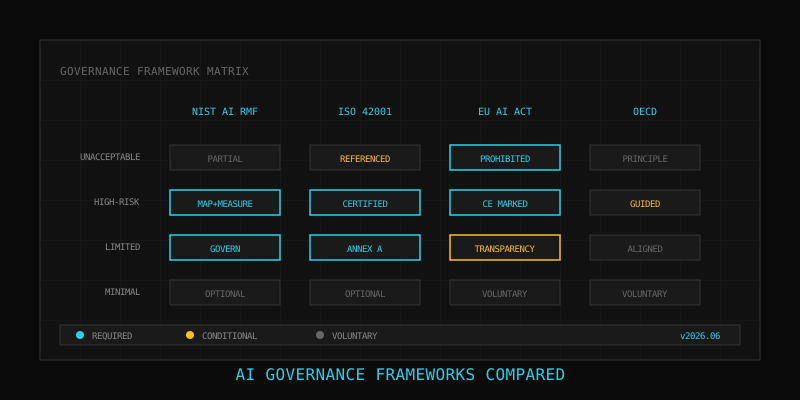
Five governance frameworks. Three regulators with overlapping jurisdiction. One CEO standing in front of a board slide asking which one to actually implement before the auditor knocks. That is the conversation happening inside roughly every enterprise AI program over a hundred employees in 2026, and most of the answers being offered are the wrong shape. People want to know which framework is best. The right question is which combination clears the legal floor, satisfies the procurement gate, and survives audit without forcing the engineering team to rebuild every model card from scratch.
We compare the five frameworks that matter — NIST AI RMF, ISO/IEC 42001, the EU AI Act, OECD AI Principles, and the Singapore Model AI Governance Framework — and add the UK AI principles as a sixth reference point. Each has a different ambition, a different enforcement mechanism, and a different cost to implement. Pick wrong and you spend eighteen months building a control library nobody recognizes. Pick right and you can layer one set of controls across three obligations at once.
Why governance framework choice matters now
Three things changed between 2024 and 2026. First, the EU AI Act moved from text to enforceable obligations: prohibited practices became enforceable in February 2025, general-purpose AI model obligations kicked in August 2025, and the high-risk system requirements activate in August 2026. Second, ISO/IEC 42001 — the first certifiable AI management system standard — published in late 2023 and certification bodies caught up through 2025, meaning your buyer can now demand a certificate the way they demand SOC 2. Third, US federal procurement guidance (OMB M-24-10 and successors) started referencing NIST AI RMF by name, turning a voluntary framework into a de-facto prerequisite for selling to government.
The cost of getting this wrong is no longer theoretical. EU AI Act penalties top out at 7% of global annual turnover or 35M EUR, whichever is higher, for prohibited practices. High-risk violations cap at 3% or 15M EUR. On the buyer side, enterprises with mature procurement now bounce vendors who cannot produce either an ISO 42001 certificate or a documented NIST AI RMF profile. The framework question stopped being academic the moment it became a line item in the security questionnaire.
NIST AI RMF: structure and gaps
The NIST AI Risk Management Framework (RMF) 1.0 is a voluntary US framework published January 2023 with a Generative AI Profile added July 2024. It is structured around four functions — Govern, Map, Measure, Manage — each broken into categories and subcategories. Total of 72 outcomes. It is principles-based, not prescriptive, which is both its strength and its weakness.
Strength: NIST AI RMF maps cleanly onto existing enterprise risk management practices. If your organization already runs an ERM program, the RMF slots in with maybe two weeks of crosswalk work. The Govern function looks like board-level risk oversight you already do. Map and Measure are essentially a risk inventory plus impact assessment with AI-specific failure modes layered in.
Weakness: NIST AI RMF does not tell you what good looks like. It tells you to measure bias, but not which metrics. It tells you to manage risk, but not which thresholds. Two organizations can both claim NIST AI RMF alignment and have wildly different control rigor. There is no certification, no auditor sign-off, no badge. For internal discipline, that flexibility is a feature. For external trust, it is a problem.
Use NIST AI RMF when: you sell to US federal agencies, you already have a mature ERM function, you want a common vocabulary across the enterprise without committing to a certification cycle. Avoid relying on it alone when: your buyer needs proof, not principles. We covered the foundational mechanics in our earlier AI governance frameworks overview if you want the deeper walkthrough.
ISO/IEC 42001: certification path
ISO/IEC 42001:2023 is the world's first certifiable AI management system standard. Same structural DNA as ISO 27001 (information security) and ISO 9001 (quality management) — Annex SL harmonized structure, Plan-Do-Check-Act cycle, mandatory clauses, Annex A controls. If you have already done ISO 27001, you know the shape of the work.
What makes 42001 different from NIST AI RMF is the certification. An accredited body audits you. You either pass or you do not. The certificate is renewable annually with surveillance audits. Procurement teams treat it like SOC 2 — a checkbox that ends a conversation. The cost is real: typical first-time implementation runs 80,000 to 250,000 EUR depending on AI inventory size and existing management system maturity, with annual surveillance audits at 15,000 to 40,000 EUR thereafter.
The Annex A controls (38 of them, organized into 9 control categories) are where the rubber meets the road. They cover AI policies, internal organization, resources for AI systems, impact assessments, lifecycle management, data for AI, information for interested parties, third-party AI relationships, and use of AI. If you already documented a model risk policy, vendor due diligence for AI suppliers, and an impact assessment process, you are halfway to 42001.
Use ISO 42001 when: you sell to enterprise buyers in regulated industries, you have existing ISO management systems, your sales cycle has stalled on questions about AI assurance. Skip it when: your AI footprint is small, your buyers do not ask for certificates, your engineering culture rejects formal management systems.
EU AI Act: where it intersects
The EU AI Act is not a framework you choose. It is a law that chooses you if you place AI systems on the EU market, put them into service in the EU, or use outputs in the EU. Extraterritorial. The framework question is not "do I comply" but "which framework gives me the cheapest path to compliance."
Four risk tiers structure the Act:
| Risk Tier | Examples | Obligation | Enforcement Date |
|---|---|---|---|
| Unacceptable | Social scoring, real-time biometric ID in public | Prohibited | Feb 2025 |
| High-risk | HR screening, credit scoring, medical devices | Conformity assessment + CE marking | Aug 2026 |
| Limited risk | Chatbots, deepfakes, emotion recognition | Transparency labeling | Aug 2026 |
| Minimal risk | Spam filters, recommendation engines | Voluntary codes of conduct | N/A |
General-purpose AI model providers picked up obligations in August 2025 — documentation, copyright policy, training summary publication, and systemic risk obligations above 10^25 FLOPs. For deployers (most enterprises that buy rather than build models), the heaviest lift is high-risk system deployment: human oversight, logging, accuracy and robustness testing, post-market monitoring, and incident reporting.
Where this intersects with framework choice: an ISO 42001 certificate creates a presumption of conformity with the EU AI Act's management system obligations under Article 17. NIST AI RMF does not. So if EU exposure is real, ISO 42001 stops being optional flair and becomes the cheapest legal path. Our earlier coverage in EU AI Act 2025 implementation guide walks through the conformity assessment mechanics.
OECD, Singapore Model AI, UK AI principles
Three reference frameworks that show up in policy conversations and rarely in actual procurement requirements, but worth understanding because they shape how the bigger frameworks will evolve.
OECD AI Principles (2019, updated 2024) are the philosophical bedrock. Five values-based principles — inclusive growth, human-centered values, transparency, robustness, accountability — adopted by 47 countries including all G20 members. They are not implementable. They are aspirational. Their value is signaling: when your customer asks about responsible AI, citing OECD alignment is the polite floor. It does not produce evidence; it produces vocabulary.
Singapore Model AI Governance Framework (2nd edition, 2020; Gen AI version 2024) is the most practical of the soft frameworks. Two parts: a conceptual governance model and an implementation playbook. Singapore also publishes AI Verify, an open-source testing toolkit. If you operate in Southeast Asia or sell into Singapore government tenders, the Model Framework plus AI Verify is the local standard. It maps cleanly onto NIST AI RMF — roughly 80% overlap by our analysis of the 2024 Gen AI edition.
UK AI principles (2023 White Paper, refined 2024) take a sector-specific approach: instead of a horizontal AI law, individual regulators (ICO, CMA, Ofcom, FCA) issue AI guidance within their existing mandates. Five cross-cutting principles — safety, transparency, fairness, accountability, contestability — but no central AI authority. Result: if you operate in UK financial services, the FCA's guidance carries the weight; in healthcare, the MHRA's. There is no single UK AI certification to chase.
Decision matrix: which framework for which company
Stop treating these as alternatives. The mature posture is a layered stack: a baseline framework for internal discipline, a certification for external trust, and explicit mapping to whichever regulations actually bind you. Here is how we sequence framework choice based on the variables that matter.
| Company Profile | Primary Framework | Certification | Regulatory Layer |
|---|---|---|---|
| US SaaS, no EU exposure, federal sales | NIST AI RMF | Optional ISO 42001 | Sectoral (HIPAA, FCRA, etc.) |
| EU-based or EU customers | ISO/IEC 42001 | ISO 42001 required | EU AI Act mandatory |
| Global enterprise, multi-jurisdiction | ISO/IEC 42001 | ISO 42001 + SOC 2 | EU AI Act + NIST AI RMF crosswalk |
| Singapore/SEA operations | Singapore Model AI | AI Verify testing | PDPA + sectoral |
| UK-only, regulated sector | NIST AI RMF | Sector-specific | FCA / ICO / MHRA guidance |
| Early-stage, AI-native, no regulated customers | NIST AI RMF (lite) | None yet | OECD signaling |
Three rules embedded in that matrix worth pulling out:
- If EU exposure is real, ISO 42001 pays for itself. The Article 17 presumption of conformity reduces your EU AI Act conformity assessment cost by an estimated 30 to 50 percent and shortens the timeline by months. If your EU revenue is over 5M EUR, the certification cost is rounding error.
- NIST AI RMF is the lingua franca. Even if you certify against ISO 42001, your internal teams will think in NIST functions. Govern-Map-Measure-Manage is a better vocabulary than the ISO clauses for engineering conversations. Run them in parallel — ISO for the auditor, NIST for the engineering review.
- Do not chase certifications you cannot maintain. ISO 42001 requires continuous evidence, internal audits, management reviews, and surveillance audits. If your organization has never sustained an ISO 27001 program, do not lead with 42001. Start with NIST AI RMF alignment and a documented control library, then graduate.
How to apply this without burning a year
The trap most enterprises fall into is treating framework adoption as a documentation project. It is not. It is a control project with documentation as the artifact. The sequence that works in our experience:
- Inventory first, framework second. Before you pick a framework, list every AI system in production, in development, and in vendor stack. Owner, purpose, data, decisions affected. Most enterprises discover 3x more AI systems than they expected. The framework you choose depends on what is actually in the inventory, not the imaginary AI program in the deck.
- Map obligations to inventory. For each system, which regulations apply? EU AI Act high-risk? GDPR Article 22? FCRA? The intersection of system inventory and regulatory obligation gives you the actual control requirements. The framework is the wrapper.
- Pick the wrapper that minimizes duplicate work. If 80% of your inventory is EU-exposed, start with ISO 42001 because it gives you the Article 17 presumption. If 90% is US federal, start with NIST AI RMF because the Generative AI Profile maps directly to OMB guidance. Pick based on the math, not the marketing.
- Build the control library, not the policy library. Auditors and customers want evidence: impact assessments, model cards, monitoring logs, incident reports, vendor due diligence. Policies are the minimum viable artifact. Controls running in production are the actual asset. Spend 70% of effort on the evidence layer.
- Cross-walk once, reuse forever. Build a single control library and map each control to NIST AI RMF subcategories, ISO 42001 Annex A controls, and EU AI Act articles simultaneously. One control, three regulatory citations. This is the work that converts a six-month compliance death march into a six-week rollout. Our practical playbook in audit-ready AI covers the evidence layer in detail.
What changes in 2026 and 2027
Three regulatory waves are visible on the 18-month horizon. First, EU AI Act high-risk obligations enforce in August 2026 — every conformity assessment process that has not started by Q2 2026 is already late. Second, US state-level AI laws are proliferating: Colorado AI Act enforces February 2026, California's SB-1047 successor legislation is in committee, and at least 12 other states have bills in active draft. Third, ISO is publishing sector-specific extensions to 42001 starting late 2026 — healthcare, financial services, automotive — which will tighten what "certified" means in those verticals.
The enterprises that win the next 24 months will not be the ones with the thickest policy binders. They will be the ones with a control library that runs continuously, mapped to multiple frameworks, generating evidence automatically, and reviewed quarterly against the regulatory drift covered in our AI regulatory landscape tracker. Pick the framework, but build the operating system.
Key takeaways
- NIST AI RMF is the vocabulary; ISO 42001 is the certificate; EU AI Act is the law you cannot opt out of
- If EU revenue exceeds 5M EUR, ISO 42001 certification pays for itself via Article 17 presumption
- OECD, Singapore Model, and UK principles are reference layers, not implementation frameworks
- Inventory before framework — most enterprises discover 3x more AI systems than expected
- Build one control library mapped to three frameworks simultaneously; do not duplicate work
- EU AI Act high-risk enforcement August 2026 — any conformity work not started by Q2 2026 is late
Learn more: How it works · Why bundles beat raw thread history