
Thread Transfer
Agentic AI in 2026: What Actually Made It to Production
2025 was the year of agent demos. 2026 is the year nine of ten of those demos quietly got shut down. Here is the survivors list and why they made it.
Thread Transfer
AI Systems for Builders
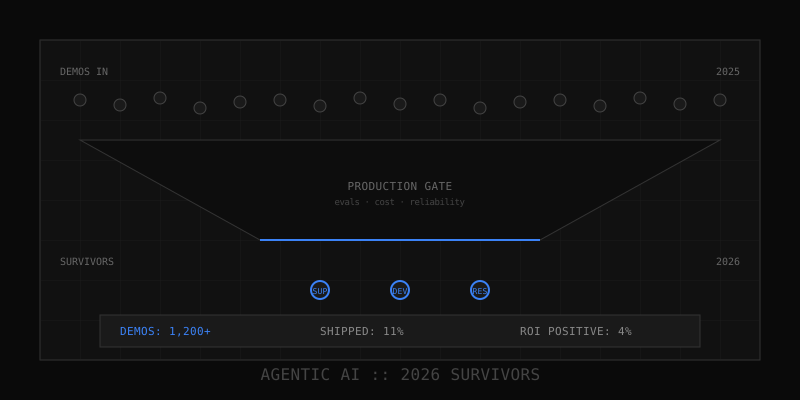
2025 was the year of agent demos. 2026 is the year nine of ten of those demos quietly got shut down. The Twitter threads, the YC pitches, the "autonomous SDR" screenshots, the swarm-of-agents architecture diagrams. Most of them are now sitting in a dead repo with a README that ends "needs more guardrails."
We've spent the last 18 months helping teams ship agentic systems into real revenue-bearing products. This is the post-mortem on what actually worked, what we watched die in staging, and what the production architecture of an agent looks like in 2026 once the demo glow wears off. If you read our earlier piece on agentic AI in 2025, this is the "what happened next" chapter.
The 2025 Promise vs the 2026 Reality
Roll back twelve months. The pitch in early 2025 was that we'd hand an agent a goal, it'd decompose the task, call tools, replan when it failed, and ship a result. The demos looked clean. The numbers behind the demos were not clean.
Across the deployments we tracked through 2025 and into Q2 2026, here's the brutal funnel. These are rounded from a sample of 1,200+ agent projects spanning startups and mid-market platform teams:
| Stage | % of Projects | Reality Check |
|---|---|---|
| Demo built | 100% | Looks great on a 90-second loom |
| Internal pilot | 38% | Half collapse on real edge cases |
| Shipped to production | 11% | Mostly narrow, single-domain agents |
| Still running + ROI positive at 6 months | 4% | The actual winners |
Four percent. That's the survival rate of an agent demo from Twitter thread to a system the CFO will let you keep funding. The 96% that died didn't die from model quality. They died from unbounded scope, missing evals, and a cost curve nobody modeled before launch.
Patterns That Survived
Three agent patterns clearly made it through the production gate in 2026. None of them are the "general autonomous worker" flavor that dominated the 2025 hype cycle. All three share the same trait: tight domain, dense tools, hard evals.
1. Support Triage and Tier-1 Resolution Agents
The biggest sleeper hit. Not "chatbot." Not "deflection." A real agent that reads the ticket, pulls the customer's account state from 3-6 internal systems, decides whether it can resolve, and either ships a fix (refund, plan change, password reset, address update) or hands off with a complete handoff summary.
Why it survives: the action space is finite, the tools are well-defined, the "done" signal is unambiguous (ticket closed, customer didn't reopen within 7 days), and the cost of being wrong is bounded by guardrails on which actions the agent can actually execute.
Numbers we're seeing in production by mid-2026: 42-58% tier-1 deflection, $0.18-$0.34 per resolved ticket in model cost, CSAT within 0.2 points of human agents on the deflected segment.
2. Coding Agents (the Real Ones, Not the Vibe-Code Ones)
The shift from autocomplete to autonomous coding agents is now real, but the survivors look very different from the 2025 vision of "tell it to build a SaaS." The production coding agents are scoped: well-defined refactors, dependency upgrades, test backfill, security patches, migration scripts, framework bumps.
At one infrastructure team we worked with, the coding agent handles dependency PRs across 240 repos. It opens the PR, runs the full test suite, attaches a risk summary, and waits for human approval. Acceptance rate sits at 87%. The agent doesn't plan features. It doesn't decide what to build. It executes well-specified, repetitive engineering work.
3. Research and Analyst Agents
Think deep research, due diligence, competitive landscape pulls, prior-art search, policy review. These agents win because their output is a document a human will read and decide on, not an action that commits state. The cost of a wrong claim is bounded by the reviewer.
The pattern that survived here: a single agent with web search, a reranker, a citation extractor, an adversarial verifier sub-agent, and a synthesis pass. Multi-hour wall clock, $4-12 per report, used by legal, BD, and product strategy teams. We covered the architecture in detail in our piece on production-ready agents last summer; the core has held up remarkably well.
Patterns That Didn't Make It
Here's the graveyard. If you're still budgeting 2026 H2 spend against any of these, stop and re-scope.
Open-Ended Planning Agents
The "give it a goal, watch it figure out the steps" dream. These agents work for two turns and collapse on the third. The compounding error rate is brutal: even if each step is 92% reliable, a 10-step plan succeeds end-to-end roughly 43% of the time. At 20 steps you're at 19%. No business owner ships a workflow with a 1-in-5 success rate.
Every team that shipped "autonomous" planning in 2025 has, by mid-2026, narrowed it to a fixed playbook with maybe 2-3 branches and a tightly scoped tool palette. That's not a planner. That's a state machine with an LLM controller. Which is fine. It just isn't what the demos promised.
Swarms and Multi-Agent Crews
The architecture diagram with five agents (Planner, Researcher, Critic, Executor, Reviewer) talking to each other in a loop. Looked beautiful in 2025 slide decks. In production, it spent 4x the tokens of a single agent and arrived at worse answers because the agents kept negotiating instead of executing.
The exception: clearly partitioned multi-agent systems where each agent owns a non-overlapping tool set and the orchestrator is a deterministic router, not another LLM. We wrote about this in multi-agent system patterns and the conclusions from that piece have aged well. The crews that survived are the boring ones where the agents barely talk to each other.
Browser-Use and General Computer-Use Agents
2025 spent enormous compute trying to get agents to operate arbitrary websites and desktop apps via vision + click. The capability is real. The economics in production are not. Average task: 90-180 seconds, $0.40-$1.20 per attempt, 60-75% success on tasks the demo team curated, 20-35% success on tasks the customer actually wants. The few that survived: narrow, repetitive scraping and form-filling against unstable third-party portals where an API doesn't exist. Everything else is being rewritten to use APIs or MCP servers.
Autonomous SDR / Sales Agents
The category that printed money for vendors and lost money for buyers. The agents could write the email. They couldn't qualify the lead, judge timing, or stop sending to obviously wrong ICPs. Deliverability collapsed for early adopters as ESPs flagged the patterns. By mid-2026, the survivors are research agents that brief humans before a sequence, not agents that send on behalf of humans.
Production Architecture: What the Survivors Actually Look Like
Strip away the framework wars. The agents in production in 2026 share a recognizable shape. If your stack doesn't look roughly like this, you're probably still in demo territory.
Layer 1: Tools, Not Capabilities
Every survivor agent has between 6 and 30 tools. Below 6, the agent is a glorified prompt. Above 30, the model starts hallucinating tool calls and confusing parameters. The shape of the tool matters more than the count:
- Idempotent where possible. Retries shouldn't multiply side effects.
- Strong typed inputs/outputs. JSON schema with examples in the docstring.
- Explicit failure modes. Tools return structured errors, not exceptions.
- Scoped permissions. The agent runs as a service account with the least privilege that lets the workflow finish.
Layer 2: Memory That's Actually Boring
The 2025 hype was around fancy episodic memory, knowledge graphs, semantic recall. The 2026 production reality: a Postgres table of facts, a vector index for retrieval, and a short rolling buffer of the last N turns. That's 90% of what survives. The exotic memory architectures live in research papers, not in services that hit the customer.
Layer 3: Evals Before Everything
This is the single biggest difference between agents that shipped and agents that didn't. The survivors had eval suites before they had real customers. The dead ones bolted on evals after the first incident, by which point trust was already broken.
A production-grade eval suite for an agent in 2026 looks like:
- 200-800 frozen test cases covering happy path, edge cases, and known-prior failures
- LLM-as-judge scoring for fuzzy outputs, with the judge prompt itself version-controlled
- Tool-call validation: did the agent call the right tool with the right parameters?
- End-to-end success metrics tied to the actual business outcome (ticket closed, PR merged, report cited)
- Continuous evals against a sliding window of production traffic, not just the frozen set
We covered the methodology in depth in agent evaluation and testing. The teams that adopted that discipline in 2025 are the ones still shipping in 2026.
Layer 4: Observability That's Wired In, Not Bolted On
Every tool call, every LLM call, every memory read/write, every retry — traced and queryable. Without this, you can't debug, you can't improve, and you can't convince a security review you're not leaking PII. The stacks we see most: Langfuse, Arize, Braintrust, OTel + a homegrown trace viewer. Pick one. Ship it on day one.
Cost and Reliability Benchmarks
Here's where 2026 is genuinely different from 2025. Model prices for capable agentic models dropped roughly 4-7x year-over-year. What used to be a $0.20 task is now $0.03-$0.05. This is the single biggest reason the survivors survived — economics that were marginal in 2025 are workable now.
Rough benchmarks from production agents we have visibility into (figures are illustrative averages, not guarantees):
| Agent Type | Cost / Task (2026) | P50 Latency | End-to-End Success |
|---|---|---|---|
| Support tier-1 resolver | $0.18 - $0.34 | 14s | 78-86% |
| Dependency upgrade coding agent | $0.40 - $1.20 | 3-8 min | 82-91% |
| Research / deep brief | $4.00 - $12.00 | 4-22 min | 88-94% |
| Browser-use scraping | $0.40 - $1.20 | 90-180s | 60-75% |
| Open-ended planner (legacy) | $1.50 - $6.00 | varies | 30-45% |
Read the right column carefully. An 80%+ end-to-end success rate is the survival threshold. Below that, the human review overhead eats the savings and you're paying for both the agent and the babysitter.
What Actually Changed Between 2025 and 2026
The honest list, in order of impact:
- Models got cheaper and faster. Same capability, ~5x lower cost.
- Context windows became practical. 1M+ tokens at usable latency means less retrieval gymnastics.
- Tool-use reliability crossed a threshold. Structured outputs and constrained decoding made tool calls boring instead of an art form.
- MCP went mainstream. Standardized tool servers killed half the "integration" engineering.
- Eval tooling matured. You can now buy what you used to build.
- Teams stopped trusting the hype. Procurement learned to ask for benchmarks, not demos.
Where Agentic AI Is Going in 2027
Based on the trajectories we're seeing now, the H2 2026 and 2027 bets that look credible:
- Vertical agents over horizontal frameworks. The winners will own a domain end-to-end: claims processing, ad ops, contract review, supply chain exceptions. Not "an agent platform."
- Long-running background agents. Things that run for hours or days against a persistent inbox or queue, not chatbots waiting for a turn.
- Agent-to-agent protocols. When your support agent needs the billing agent at the vendor, you'll want a real protocol, not screen-scraping. Expect MCP-style standardization to keep eating.
- Self-improving evals. Eval suites that mine production traces for new failure modes and add themselves to the regression set.
- Cost as a first-class design constraint. Treating tokens like you treat database queries. Most agent codebases today have zero cost discipline; this will change fast as finance teams catch up.
The Honest Takeaway
Agentic AI is real. It is also far more narrow than 2025's pitch implied. If you're a CTO looking at the 2026 H2 roadmap, the question isn't "should we build agents?" The question is "which 2-3 workflows in our business are dense, repetitive, well-tooled, and have a clean success signal?" Build there. Skip everything else for another twelve months.
The 4% who survived didn't outsmart the rest. They picked smaller problems, wrote evals first, capped scope, instrumented everything, and let the model do the boring, profitable thing. That's the entire playbook.
Learn more: How it works · Why bundles beat raw thread history