
Thread Transfer
Abuse Management Tools for AI Platforms: Detection, Response, and Stack
AI products attract abusers at three times the rate of legacy SaaS. Most platforms ship detection but no response loop. Here is the stack that actually deters abuse.
Thread Transfer
AI Systems for Builders
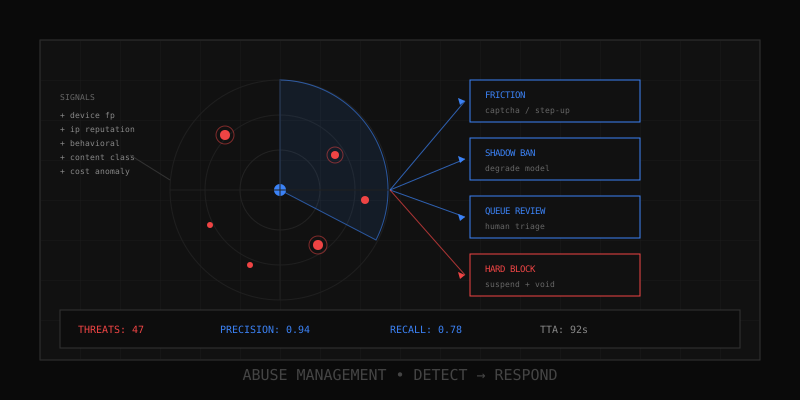
AI products attract abusers at roughly three times the rate of legacy SaaS. We have seen platforms cross 10,000 MAUs and discover, on the same week, that 8 percent of their accounts are scraping completions for a competitor, 3 percent are running prompt injection probes against the system prompt, and at least one is spending $40/day on tokens charged to a stolen card. The product team ships detection dashboards. Almost nobody ships the response loop. That is where abuse becomes unit economics damage.
Most "abuse management" tooling marketed in 2026 is just classification with a Slack alert. The real stack is detection plus response plus governance, and it has to run in under 800ms for inference paths or it becomes a UX tax. This post walks through the 2026 landscape, the signal sources that matter, the response actions that actually deter abuse, the vendor categories worth evaluating, and the metrics that tell you whether you bought a tool or a placebo.
The 2026 abuse landscape for AI products
Four abuse categories dominate AI platform incident reports this year. They overlap, and a single attacker often runs all four sequentially against the same target.
| Abuse Type | Share of Incidents | Median $ Loss | Detection Difficulty |
|---|---|---|---|
| Prompt injection / jailbreak | 34% | $2,400 | Medium |
| Output scraping / distillation | 28% | $18,000 | Hard |
| Account takeover (ATO) | 22% | $6,100 | Medium |
| Payment fraud / token theft | 16% | $3,800 | Easy |
Two things stand out. Scraping is the most expensive single category because attackers extract a synthetic training set worth more than any individual subscription. And prompt injection is the most common because the attack surface — the system prompt and tool-calling layer — is exposed on every request. A platform that only defends against payment fraud is solving the cheapest 16 percent of the problem.
The threat model also shifted. In 2024 the typical attacker was a researcher posting jailbreaks on Twitter for clout. In 2026 the typical attacker is automated: a scraper farm rotating residential proxies, paying $0.40 per fresh email/phone via SIM-farm marketplaces, and harvesting completions at industrial scale. Defenses designed for one-off researchers do not survive contact with a 5,000-account scraping operation. If you have not read our piece on LLM security guardrails, start there — guardrails are the prerequisite layer this post sits on top of.
Detection: signal sources and ML classifiers
Detection is not a model. It is a fusion of signals scored together. Treating detection as "we will fine-tune a classifier on jailbreak prompts" fails because attackers iterate faster than your training cycle. The stack that works in production blends device, behavioral, content, and economic signals.
Signal source #1: Device and network
Fingerprinting via canvas, audio context, WebGL, and TLS ja4 hashes catches the 60 percent of automated abuse that runs through Playwright or curl with default headers. Layer this with IP reputation (Spur, IPQualityScore, MaxMind) and proxy/VPN detection. A clean fingerprint plus residential IP plus brand-new account on a high-cost endpoint is a classic distillation pattern.
Signal source #2: Behavioral biometrics
Time-to-first-prompt, prompt-to-prompt cadence, scroll patterns, and copy-paste ratio differentiate humans from bots. A human writes prompts at roughly 35 words per minute with bursty edits. A scraper hits your completion endpoint every 1.2 seconds with no UI interaction. We have seen platforms catch entire scraping farms by flagging accounts whose median inter-request gap variance is under 50ms.
Signal source #3: Content classifiers
This is the prompt-injection layer. The credible options in 2026 are Lakera Guard, Prompt Armor, Protect AI Recon, and self-hosted Llama Guard 3 or Granite Guardian. Benchmark them against your own attack corpus, not the vendor demo. Public benchmarks show 70-94 percent recall on injection — but recall on novel injection (post-training-cutoff) is closer to 40-65 percent. Treat content classifiers as a thick filter, not a wall.
Signal source #4: Economic anomalies
Tokens per session, cost per user per day, and tool-call patterns are the cleanest signal you have. A legit user on a $20/month plan generates somewhere between $0.40 and $4 of inference cost monthly. An account producing $12 of cost in 6 hours is either a power user or a distiller. Set hard caps at the 99th percentile of legitimate usage and route the overflow to manual review. This is also where LLM observability overlaps directly with abuse management — the same per-request cost trace feeds both dashboards.
Fusion: scoring, not gating
Each signal returns a probability. A weighted gradient-boosted model (XGBoost is still fine in 2026) takes the ensemble and emits a single risk score 0-100. Single-signal gates produce a flood of false positives. Fusion lets you operate at a precision threshold you can defend to support.
Response: automated actions and human review
Detection without response is a vanity dashboard. The response loop has to span four tiers, each calibrated to a confidence band, and each with a reversibility contract.
| Risk Score | Action | Reversibility | Time-to-Action |
|---|---|---|---|
| 0-39 | Log only | N/A | < 50ms |
| 40-69 | Add friction (CAPTCHA, rate limit, step-up auth) | Auto-reverse on success | < 200ms |
| 70-89 | Soft block (shadow ban, degraded model, queue review) | Reverse on human review | < 800ms |
| 90-100 | Hard block (suspend, void session, refund-and-ban) | Appeal only | < 2s |
The two actions that disproportionately deter abuse are shadow ban and model downgrade. Hard blocks tell the attacker to spin up a new account on a fresh proxy. Shadow bans waste their token budget on degraded output they think is real. We have customers whose abuse rate dropped 40 percent in 14 days after replacing hard-block default with shadow-ban-then-block.
Human review queue design
Anything in the 70-89 band needs a human. The queue has to be triaged by expected $ loss, not by FIFO. A scraper costing $80/day is more urgent than 30 jailbreak probes costing $0.04 each. Build the queue with:
- Auto-summary of the last 20 events per account (prompt excerpts, tool calls, cost trail)
- One-click actions: dismiss, soft block, hard block, refund-and-ban
- SLA timers visible per case (default 4 hours for soft, 1 hour for hard candidates)
- Audit trail of who reviewed what and when — non-negotiable for audit-ready AI postures
Tooling categories and notable vendors
Five vendor categories cover the practical stack. None of them does the whole job. Stitch picks from each layer based on what your platform actually loses money on.
Category 1: Identity and device intelligence
FingerprintJS, Castle, Persona, Sift, and SEON dominate. Pricing ranges $0.005-$0.02 per device check at volume. For AI products specifically, FingerprintJS plus a residential proxy IP feed (Spur or IPQualityScore) is the baseline. Budget roughly $1,200-$4,000/month at 1M MAU.
Category 2: AI-specific content moderation
Lakera Guard, Prompt Armor, Protect AI Recon, Robust Intelligence, and HiddenLayer. These specifically score prompt injection, jailbreak, PII leakage, and policy violation. Per-request pricing is $0.0001-$0.0008. Self-hosting Llama Guard 3 8B brings it under $0.00005 per request if you have spare GPU capacity.
Category 3: General fraud / ATO platforms
Sift, Forter, Kount, and Stytch handle login and payment fraud well but were not built for AI-specific abuse like scraping or injection. Useful for the ATO and payment slice. Skippable if your auth is already on Stytch or Auth0 with their built-in risk scoring.
Category 4: Bot management
Cloudflare Bot Management, DataDome, HUMAN, and PerimeterX/Human Defense Platform. These sit at the edge and kill the dumb 70 percent of scraper traffic before it ever hits your inference layer. Critical for unit economics — a request blocked at the edge costs you nothing. Inference-layer detection of the same request burns 2,000 tokens before you decide.
Category 5: Case management and orchestration
Unit21, Hawk AI, and home-rolled Retool/Linear setups. This is where the human review queue and audit trail live. Underrated layer — most platforms underinvest here, then can't answer regulator questions about how a suspension decision was made.
Build vs buy decision
The build-vs-buy question is not binary. The honest answer is: buy the edges, build the core. Edges (device fingerprinting, IP reputation, bot management) commoditize fast and have economies of scale you cannot match. Buy them. The core (risk fusion model, response orchestration, case queue) is where your product knowledge lives. Build it.
A useful heuristic: if a vendor charges per inference request and your gross margin on that request is under 65 percent, the vendor is eating your margin. AI-specific content moderation per-request costs at $0.0005 add up at 50M monthly requests to $25,000/month. At that scale, self-host Llama Guard 3 and reinvest the difference in your risk fusion model.
| Layer | Buy | Build | Trigger to switch |
|---|---|---|---|
| Device fingerprint | Always | Never | — |
| IP reputation | Always | Never | — |
| Bot management | Until 10M req/day | Above that | Vendor cost > 1.5% of revenue |
| Content moderation | Until 5M req/day | Above that | Per-req cost > $0.0003 |
| Risk fusion | Never | Always | — |
| Case queue | Optional | Recommended | Team > 5 reviewers |
Metrics: precision, recall, time-to-action
If you cannot quote your precision and recall to two decimal places, you do not have an abuse program. You have a Slack channel. The numbers that matter:
- Precision at action threshold: of accounts you blocked, what percentage were actually abusive. Target 92 percent or higher for hard blocks. Anything under 85 percent triggers a support backlash that costs more than the abuse.
- Recall at 24h: of confirmed abuse cases (from chargebacks, manual reports, post-hoc audits), what percentage did your system catch within 24 hours. Target 75 percent. Most platforms launching their first program land at 30-45 percent.
- Time-to-action (TTA): median time from first abusive request to first response action. Target 90 seconds for automated, 4 hours for human-reviewed. TTA above 24 hours means the attacker is already done.
- Cost-of-abuse ratio: $ lost to abuse / $ revenue. Anything above 2 percent is a board-level problem. Below 0.5 percent and you may be overspending on tooling.
- False positive cost: dollar value of refunds, support tickets, and churn caused by incorrect blocks. Track separately from precision.
Instrument before you optimize
We have audited platforms that bought $80K/year of abuse tooling and could not tell us their recall. They measured "blocks per day" — a meaningless number that goes up when attackers attack more and down when defenses work. The right metrics require a labeled ground truth set built from confirmed cases. If you do not have one yet, spend a week building it before buying anything.
What to do this quarter
A pragmatic 90-day rollout for a platform between 10K and 500K MAU:
- Week 1-2: Instrument. Add per-request cost tracking, device fingerprint capture, and a basic content classifier in shadow mode (log, don't block). Build the labeled ground truth set from your last 90 days of chargebacks and support tickets.
- Week 3-4: Deploy bot management at the edge (Cloudflare Bot Management is the lowest-lift option). Expect to kill 30-60 percent of scraper traffic immediately at near-zero cost.
- Week 5-8: Build risk fusion v1. Start with a logistic regression on 8-12 signals. Resist XGBoost until you have 5,000+ labeled examples. Deploy in shadow mode for two weeks before any blocking action.
- Week 9-10: Wire response orchestration. Implement shadow ban and model downgrade — these do more work than hard blocks. Build the case queue with auto-summary and one-click actions.
- Week 11-12: Tune thresholds against your precision and recall targets. Set up weekly review of the cost-of-abuse ratio and FP cost. Decide which vendor layers to renew vs replace.
The platforms that get abuse management right in 2026 are not the ones that bought the most tools. They are the ones that closed the loop: detection feeds response, response feeds the case queue, the case queue feeds labeled training data, labeled data improves detection. Everything else is dashboards.
Learn more: How it works · Why bundles beat raw thread history