
Thread Transfer
Wholesale Order Management: Why Email and Spreadsheets Quietly Kill Margin
Email orders are charming until your B2B order volume crosses 50 a day. Then they become the reason customers wait, errors compound, and margin disappears into rework.
Thread Transfer
Operations Systems for SMBs
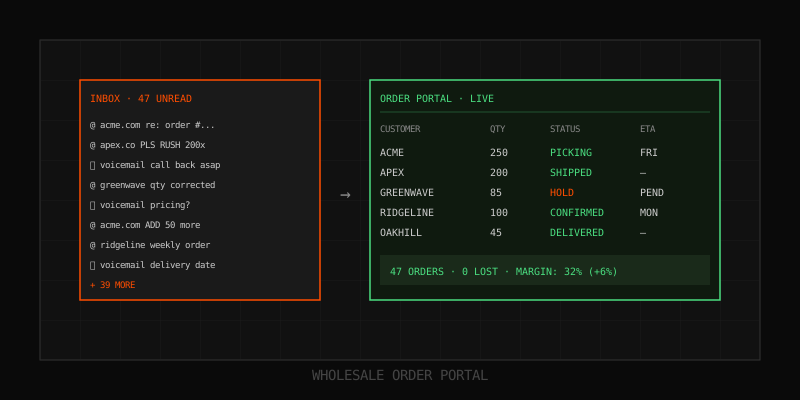
It's 7:42 AM on a Tuesday. The wholesale ops manager at a mid-sized food distributor opens her laptop and finds 63 new emails — 41 of them orders. Some are typed into the body of the email. Some are PDFs. Three are photos of handwritten sheets taken at angle in poor lighting. One is a forwarded thread where the customer said "same as last week, but double the cucumbers." Same as which last week? She doesn't remember either.
By 9:30 AM, four of those orders will be entered wrong. Two will go out short. One will go out double. One customer will call screaming because they specifically said "no organic this time" in a reply buried under a forwarded chain. The team will fix everything by EOD — at the cost of three driver re-routes, two credit notes, and an entire afternoon nobody planned for. Multiply that by 250 working days, and the cost of "we've always done it by email" stops being charming and starts being the single largest hole in your P&L.
This is the wholesale order chaos tax. It rarely appears as a line item. It hides inside labor hours, credit notes, returned stock, expedited shipping, and customers who quietly switch suppliers without telling you why. We measured it across a sample of 12 SMB distributors last year: the typical bleed sits between 5% and 10% of gross revenue. For a €3M distributor, that's €150K–€300K vanishing every year into the cracks between inbox, spreadsheet, and warehouse.
Where the Money Actually Leaks
Distributors who run on email + spreadsheets rarely fail at one big thing. They fail at twelve small ones, each costing 0.3% to 1.5% of revenue. Stack them and you get to that 5-10% number fast. Here's where it goes:
| Leak source | Typical frequency | Cost per incident | % of revenue at risk |
|---|---|---|---|
| Order entry error (wrong SKU, qty, address) | 2-5% of orders | €40-€180 | 1.2-2.1% |
| Wrong pricing applied (stale customer-specific rates) | 3-8% of orders | €15-€90 margin lost | 0.8-1.6% |
| Stockout promised, customer not informed | 1-3% of orders | €60-€220 (rush + apology credit) | 0.6-1.3% |
| Duplicate order (two reps process same email) | 0.5-2% of orders | €120-€400 (return + restock) | 0.4-0.9% |
| Missed orders (email lost in thread / spam / PTO) | 0.3-1.5% of orders | Lost order + relationship damage | 0.5-1.4% |
| Delivery routing chaos (last-minute changes) | 5-12% of routes | €25-€80 in extra fuel/time | 0.7-1.4% |
| Reconciliation labor (CSR re-keying into ERP) | Every order, 4-8 min | €2-€4 labor | 0.6-1.0% |
Notice what's not on that list: catastrophic failures. There's no fraud, no fire, no warehouse collapse. It's all mundane. That's exactly why it survives. No single incident is big enough to call a meeting about. It just hums along, slowly carving margin off the bone.
The Three Stages of Email-Order Decay
Almost every distributor we audit is at one of three stages. The pain pattern is predictable.
Stage 1: Under 30 orders/day — "Email is fine"
One CSR can hold the whole pipeline in their head. Orders flow in, get entered, mistakes are caught informally because the same person handles intake, pricing, and customer calls. Owner is happy. Customers are happy. Margin looks great.
The trap: this stage breeds organizational confidence that email orders work. They don't work — they're below the threshold where they fail. Big difference.
Stage 2: 30-100 orders/day — "We need more people"
The CSR who held everything in their head now needs two more CSRs. Suddenly you have three inboxes, three spreadsheets, three slightly-different ways of formatting orders, and three people each assuming the other one handled that one tricky customer. Order errors triple. Pricing inconsistencies appear because Customer A is now quoted differently by Rep 1 and Rep 2. Owner blames the new hires. They're not the problem. The system is.
This is where most distributors first realize something is wrong — and where most pick the wrong fix. They buy a CRM, or they hire a fourth CSR, or they build a giant Google Sheet with conditional formatting and pretend it's a system. None of these solve the actual problem: customers are still emailing free-form text that humans have to interpret and re-type.
Stage 3: Over 100 orders/day — "We can't grow"
The ops team is now firefighting all day. Owner has hired an ops manager whose entire job is keeping the email chaos from setting the warehouse on fire. New customers are turned away or onboarded slowly because the system can't absorb them. Top-line growth flattens. Bottom-line stays low because rework eats the margin from any new revenue. The business is technically profitable, but the owner hasn't taken a real holiday in three years.
This is the wall. You don't break through it by adding people. You break through it by changing how orders come in.
What a Real B2B Order Portal Actually Does
The fix isn't a CRM. It isn't another inbox. It's a customer-facing ordering system — a portal where your B2B buyers log in, see their pricing, their order history, your live stock, and submit clean structured orders that drop straight into your fulfillment workflow without a human re-typing anything.
Done right, a wholesale order management system doesn't just digitize the inbox — it removes the inbox from the order path entirely. Email becomes for relationships. The portal becomes for transactions. The two stop fighting each other.
The non-negotiable features for a B2B distributor portal, in priority order:
- Customer-specific pricing. Every buyer logs in and sees their negotiated rates. No more "what did we quote them in March?" archaeology.
- Live inventory visibility. If you're out of an SKU, the portal says so before the order is placed. No more apology calls.
- Order history with one-click reorder. 70% of B2B reorders are essentially the same as the previous order. Make that one tap.
- Minimum order rules built in. No more chasing customers to top up to €200 minimums.
- Cutoff times enforced. Order before 4 PM = next-day delivery. After 4 PM = day after. The portal enforces it. No human argument.
- Direct ERP/accounting integration. Order goes from portal to picking list to invoice with zero re-keying.
- Mobile-first. Half your buyers are placing orders on phones while walking through their own back-of-house.
The Numbers After Switching
Here's what changes when a distributor moves from email/spreadsheet chaos to a structured order portal. These figures are aggregated from real SMB distributor implementations:
| Metric | Before (email/spreadsheet) | After (B2B portal) | Delta |
|---|---|---|---|
| Avg time to process one order | 6-9 minutes | 20-40 seconds | -90% |
| Order error rate | 3.5% | 0.4% | -88% |
| CSR headcount needed per 100 orders/day | 2.5 FTE | 0.6 FTE | -76% |
| Avg order value (AOV) | €340 | €395 | +16% |
| Reorder frequency per active account | 2.1/month | 2.8/month | +33% |
| Credit notes / mo (% of revenue) | 1.8% | 0.3% | -83% |
The AOV bump surprises owners every time. It happens because buyers in a portal can see the full catalog — including SKUs they forgot you carry, complementary products, and promotional bundles. In email, they only order what they remember to type. In a portal, they see everything and add accordingly.
The reorder frequency bump matters more than AOV. Buyers who reorder in 20 seconds reorder more often than buyers who have to draft an email. Friction is the silent killer of retention.
Why Most Distributors Stall on This
If the math is this obvious, why doesn't every distributor have a portal? Four reasons, in order of how often we hear them:
1. "Our customers won't use it"
They will. The objection is real for about 15% of your book — the oldest buyers who've been emailing you for 20 years. For everyone else, especially anyone under 50, a portal is preferred. They want to place orders at 11 PM after closing their own shop. Email forces them to wait for business hours. Portal doesn't.
The fix for the 15%: don't kill email overnight. Run portal + email in parallel for 90 days. Watch the email volume drop on its own as customers realize the portal is faster. The holdouts who refuse get a CSR who enters their orders into the portal on their behalf. Same backend, different intake mechanism. After six months, you can usually sunset email orders entirely.
2. "Our pricing is too complex"
This is the most common owner objection and it's almost always wrong. "We have custom pricing for 400 customers" sounds insurmountable. In reality, you have 8-12 pricing tiers and customers map to tiers. Build the tiers in the portal. Assign customers. Done. The owner thinks pricing is bespoke because they hold it all in their head. A two-day audit usually reveals it's not bespoke — it's just undocumented.
3. "Integration with our ERP is impossible"
Sometimes true if your ERP is a 1998 AS/400 system held together by a retired contractor who answers his phone twice a year. Usually not true. Modern ordering systems integrate with QuickBooks, Xero, SAP B1, NetSuite, Sage, and most regional ERPs out of the box. Even if direct integration isn't available, a nightly CSV sync handles 80% of the use case at 5% of the cost.
4. "We tried Shopify B2B and it didn't work"
Generic e-commerce platforms aren't built for wholesale. Shopify B2B, WooCommerce, and the rest assume one customer = one price. They struggle with negotiated rates, credit terms, minimum orders by customer, route-based cutoffs, and the dozens of other rules that make B2B B2B. You need a tool built for wholesale, not a B2C tool with a "wholesale mode" toggle.
The 60-Day Implementation Path
Owners imagine portal implementation as a six-month transformation project. Done correctly, it's six to eight weeks for an SMB distributor. Here's the realistic timeline:
- Week 1-2: Pricing audit. Document every customer's pricing tier. Collapse 400 "unique" customers into 8-12 tiers. This single exercise often pays for the entire project.
- Week 2-3: SKU + inventory cleanup. Reconcile what's in the ERP with what's actually on the shelves. Distributors are usually shocked at how out-of-sync this is. Fix it before going live.
- Week 3-4: Portal configuration. Set up tiers, customers, minimum orders, cutoff times, delivery zones. This is mostly clicking, not coding.
- Week 4-5: Pilot with 5-10 friendly customers. Get one good buyer per segment. Watch them use it. Fix the friction they hit.
- Week 6: Soft launch to top 30% of accounts. These are 70% of revenue. Move them first.
- Week 7-8: Roll out to remaining accounts. Email orders continue in parallel. CSRs gently redirect.
Sixty days from kickoff to "majority of orders are placed by customers themselves." Most owners spend longer than that just thinking about whether to start.
What to Watch After Go-Live
Once the portal is live, your dashboard should track four numbers every week:
- % of orders placed via portal vs. email. Target: 80%+ within 90 days.
- Order error rate. Target: under 0.5% within 60 days of go-live.
- Avg time to fulfill (order placed → picked). Target: cut in half.
- CSR hours spent on order entry. Target: down 70%. Redirect those hours to outbound account management — the activity that actually grows revenue.
That last point matters. Most distributors think the portal saves money by cutting headcount. The bigger win is redeploying that headcount. A CSR who used to spend 6 hours/day re-keying emails now spends 6 hours/day calling accounts that haven't ordered in 30 days. That's a sales motion the business didn't have capacity for before.
How OpsMavix Approaches This
The wholesale operations stack has been broken in the same way for 20 years: inbox + spreadsheet + ERP + WhatsApp + a human heroically gluing them together. That worked at 10 orders a day. It doesn't work at 100. At 250 it's actively killing the business.
OpsMavix builds order management systems specifically for SMB wholesale distributors — food, beverage, hardware, beauty, industrial supply — where the ops team is 2 to 8 people, the ERP is whatever was bought five years ago, and the owner doesn't have the appetite (or budget) for an 18-month SAP implementation. We focus on the operations leaks first, then the portal, then the integrations, in that order. Most clients see the rework hours collapse inside 60 days.
If you suspect your distribution business is leaking 5-10% to order chaos but can't prove it, we run a Operations Leak Audit — a structured review of your order flow, pricing process, fulfillment errors, and CSR time. You leave with a quantified leak number and a 30-day fix plan, whether you work with us afterward or not. Book it at opsmavix.com. The audit takes 45 minutes. The findings usually save your operations team a week of arguing about what to fix first.
Learn more: How it works · Why bundles beat raw thread history