
Thread Transfer
Why Shopify Inventory Apps Stop Working When You Scale Past $1M
Your inventory app worked great at 200 orders a month. At 2,000 orders, it's the reason you're overselling. The transition from app to custom system has a clear trigger point.
Thread Transfer
Operations Systems for SMBs
Friday, 7:14 PM. Your support inbox has 23 new tickets in two hours. Every single one says the same thing: "I just got a refund email — what happened to my order?" You sold 184 units of a product you only had 71 in stock. Your inventory app says you still have 12. Your warehouse says zero. Shopify is happily charging cards. Somewhere in that gap, your brand just took a reputation hit you can't take back.
This is what hitting the inventory app ceiling looks like. It doesn't announce itself. There's no error message, no warning email from the app's CEO. It just stops working — quietly, expensively, and at the worst possible moment, which is always during a sale, a launch, or a viral TikTok you didn't see coming.
The 200-Order Honeymoon
Off-the-shelf Shopify inventory apps — Stocky, Inventory Planner, Trunk, Katana, the entire long tail — are genuinely useful in the early stages. They sync a few hundred SKUs. They batch update levels every 10-15 minutes. They handle one or two sales channels. For a store doing 100-300 orders a month with under 500 SKUs, this is fine. You probably wouldn't even notice the cracks.
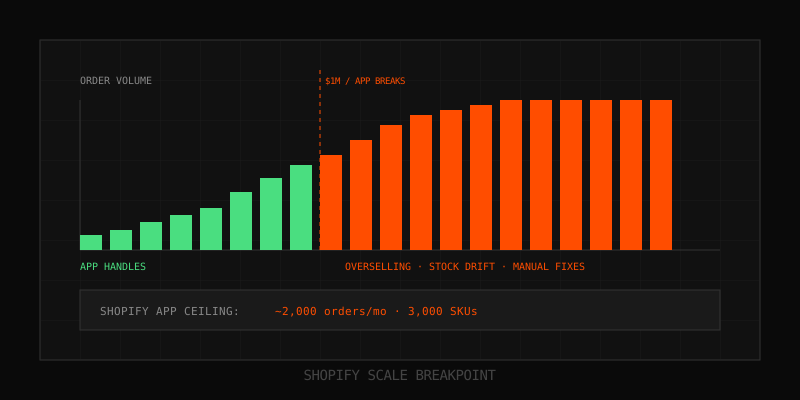
The cracks start showing around 1,500-2,500 orders per month, or when SKU count crosses ~3,000, or when you add a third sales channel, or when your supplier starts sending daily CSV feeds. By the time you hit $1M in annual revenue and you're running wholesale, Amazon, TikTok Shop, and Shopify in parallel — the app is no longer "inventory management." It's a polling cron job pretending to be a system.
What "Stops Working" Actually Means
It's worth being specific, because most operators describe this stage with vague phrases like "we keep having issues." The failure modes are concrete and predictable:
| Failure Mode | What Triggers It | What It Costs You |
|---|---|---|
| Stock desync between channels | Polling interval is 10-15 min; you sell 50 units in 4 min | Overselling, refunds, chargebacks, 1-star reviews |
| Bundle/kit math errors | App treats bundles as separate SKUs, not as parent-child | You think you have 200 bundles, you have 12 |
| Returns never decrement back | No webhook from 3PL back to inventory app | Phantom out-of-stock; you miss sales on units sitting in the warehouse |
| Supplier feed not ingested | App only supports CSV upload manually, not SFTP/API | 3-5 day lag on incoming stock visibility |
| Multi-location math breaks | Two warehouses, one app, no rule for which fulfills first | Wrong warehouse ships, customer waits 4 extra days |
| App rate limits hit | Shopify API throttles updates above 2-4 req/sec on standard plans | Updates queue, then drop silently |
Each one of these is survivable in isolation. The reason scaling stores break is that they happen simultaneously, during the exact moments revenue is highest — Black Friday, a product drop, a press hit, a paid campaign that finally cracked.
The Real Math: Cost of Overselling at $1M+
Let's stop talking abstractly. A store doing $1.2M ARR is roughly $100K/month, average order value $65, so ~1,540 orders/month. Assume 1.8% of those orders touch a SKU that's actually out of stock when the order is placed (this is conservative — we've audited stores at 4-6%).
| Metric | Per Month | Per Year |
|---|---|---|
| Oversold orders | ~28 | ~336 |
| Refunds issued (avg $65) | $1,820 | $21,840 |
| Stripe/Shopify fees not refunded | ~$80 | ~$960 |
| Support time (15 min/ticket × $25/hr) | $175 | $2,100 |
| Chargeback fees (~2 per month at $20) | $40 | $480 |
| Lifetime value loss (50% don't return, $180 LTV) | $2,520 | $30,240 |
| Total visible + invisible cost | ~$4,635 | ~$55,620 |
That's $55K a year leaking through an app you're paying $99-$299/month for. And the LTV number is the painful one — the customer doesn't churn loudly. They just never come back. You won't see it in any dashboard. It shows up as a flat repeat-purchase rate two quarters from now and you blame the ad creative.
Why Off-the-Shelf Apps Hit This Ceiling
It's not because the developers are bad. It's because of structural limits in how these tools are built. Three reasons in particular:
1. They poll instead of react
Most inventory apps sync on intervals — every 5, 10, or 15 minutes. That's fine when you sell 2 units per hour. When a paid campaign suddenly drives 60 conversions in 8 minutes, the app is still showing yesterday's number to the next 40 buyers. A real system reacts to order.created webhooks in real time and writes back to every channel within seconds, not minutes.
2. They model SKUs, not the business
Apps treat inventory as a flat table: SKU, location, quantity. Real ecommerce ops have bundles, kits, components, pre-orders, backorders, in-transit stock, allocated-but-unshipped, reserved-for-wholesale, damaged-pending-disposition, and quality-hold pallets. None of those states exist in a generic app. So your team invents workarounds: a Google Sheet, a Slack channel, a person whose job is "fixing inventory."
3. They don't talk to your supplier
Your supplier sends a daily stock-and-ETA feed by SFTP. Your inventory app accepts CSV by manual upload. So either your ops lead spends 40 minutes a day uploading a file, or supplier data lives nowhere and you re-order blind. Past a million in revenue, supplier integration stops being optional — it's the difference between a 14-day stockout and a 2-day one.
The Trigger Points: When to Replace, Not Patch
You don't replace an inventory app just because revenue crossed a threshold. The trigger is operational, not financial. Watch for any two of these happening in the same quarter:
- You've oversold 3+ times in the last 90 days. Once is bad luck. Three times is a system failure.
- Someone on your team manually exports a CSV more than once a week. That person is now the system. They will quit, get sick, or burn out.
- You're running 3+ sales channels. Shopify + Amazon + wholesale, or Shopify + TikTok + retail partners. Each new channel multiplies sync complexity.
- Returns aren't auto-decrementing the right warehouse. If returned stock requires a human to put it back into inventory, you're losing days of sellable units.
- Your forecasting and your ordering happen in different tools. Forecast in Inventory Planner, order in a spreadsheet, receive in Shopify. The gaps are where the phantom stock lives.
- You've started writing Zapier or Make automations to patch the app. Once you're duct-taping middleware around the tool, you've already left the app's intended use case. The duct tape will fail under load.
What Replaces the App
Not another, more expensive app. A custom-built ops layer that sits between Shopify, your sales channels, your 3PL/warehouse, your suppliers, and your finance stack. The transition is less dramatic than people fear — you're not ripping out Shopify. You're building the connective tissue that should have existed from day one.
A well-designed ecommerce inventory automation system handles four things that no off-the-shelf app does well at scale:
- Event-driven sync. Shopify webhook fires the instant an order is placed. Stock decrements across every channel within 1-2 seconds. No polling, no batch windows, no drift.
- A single source of truth for stock state. One database that knows the difference between "physical on hand," "allocated," "in-transit," and "available to promise." Every channel reads from the same number.
- Direct supplier and 3PL integration. SFTP/API ingestion of supplier feeds. Webhook-based return processing from the 3PL. ETA-aware reorder triggers that consider lead time, not just current stock.
- Bundle and kit math at the component level. A bundle of 3 components stops selling the instant any one component runs out. Pre-orders are tracked separately. Backorders have explicit policies, not silent overselling.
Cost Comparison: App Stack vs. Custom System
The reflexive objection to building anything custom is "it's too expensive." It's worth doing the math at $1M+ scale.
| Line Item | App Stack (status quo) | Custom Ops Layer |
|---|---|---|
| Inventory app subscription | $199/mo | $0 |
| Bundles/kits app | $79/mo | $0 |
| Multi-channel sync app | $149/mo | $0 |
| Returns app | $99/mo | $0 |
| Zapier/Make middleware | $89/mo | $0 |
| Custom system build (amortized over 24 mo) | $0 | ~$700/mo |
| Hosting + monitoring | $0 | ~$60/mo |
| Ops headcount needed to babysit it | 0.4 FTE (~$1,800/mo) | 0.1 FTE (~$450/mo) |
| Annual cost of overselling/leaks | ~$4,635/mo | ~$300/mo (residual edge cases) |
| Total monthly cost | ~$7,049 | ~$1,510 |
The custom system isn't cheaper because the build is free. It's cheaper because it eliminates the leakage that the app stack quietly tolerates. The subscription line items are the small fraction. The real cost is the operational drag.
What the Migration Actually Looks Like
It is not a year-long project. A pragmatic build for a $1-5M store is 6-10 weeks, in phases you can run while still selling:
Phase 1 (Weeks 1-2): Shadow mode
The new system reads everything but writes nothing. It mirrors stock levels from your existing app, ingests Shopify webhooks, and starts logging discrepancies. You'll learn, usually within 48 hours, exactly how much your current app is lying to you.
Phase 2 (Weeks 3-5): Authoritative for one channel
Cut Shopify over first. The new system becomes the source of truth for Shopify stock levels. The old app continues running for Amazon, TikTok, etc. You verify the new system at lower risk before expanding scope.
Phase 3 (Weeks 6-8): Supplier + 3PL integration
Wire up the SFTP feed from your supplier. Plug the 3PL webhooks for receipts, picks, and returns. This is where the most leverage shows up — the manual CSV uploads disappear.
Phase 4 (Weeks 9-10): Remaining channels + decommission apps
Cut over Amazon, TikTok, wholesale. Cancel the app stack. Pocket the $7K/month delta.
The risk during migration is real but manageable — you run both systems in parallel, reconcile nightly, and roll back any channel that drifts by more than 0.5%. Anyone telling you to flip the switch in one weekend is selling you a problem.
What to Build vs. What to Keep
Not everything needs to be custom. The principle is: custom for the data layer, off-the-shelf for the workflows on top of it. A useful split:
| Keep Off-the-Shelf | Build Custom |
|---|---|
| Shopify (storefront, checkout, orders) | The inventory state machine |
| Klaviyo (email/SMS) | Webhook router between channels |
| Gorgias / Front (support) | Supplier feed ingestion |
| 3PL portal (warehouse ops) | Bundle/kit decomposition logic |
| Analytics (GA4, Triple Whale) | Reconciliation + alerting layer |
You are not rebuilding Shopify. You're building the thing that makes Shopify, your 3PL, your suppliers, and your other channels stop lying to each other.
How OpsMavix Approaches This
At OpsMavix, we build the connective ops layer for stores that have outgrown the app stack but aren't yet at the scale where Netsuite or a full ERP makes sense. The sweet spot is $1M-$15M ARR — past the point where apps cope, before the point where enterprise software is the answer. Most of what we ship is invisible to your customers and obvious to your ops lead: stock that's right, returns that decrement, suppliers that show up in your dashboards.
If you suspect you're already past the trigger points — multiple oversells in the last quarter, manual CSV uploads, growing Zapier stack, ops people whose job is "fixing inventory" — the next step isn't a sales call. It's a Operations Leak Audit. We look at your current stack, your last 90 days of order data, your return rates, and your stock accuracy. We hand you a written report with the specific leaks, the dollar amount each one is costing, and what to do about them. Whether you build it with us or not is a separate conversation.
Run the audit at opsmavix.com. Worst case you spend an hour and learn nothing new. Best case you find the $55K/year leak you didn't know was there before your next Black Friday.
Learn more: How it works · Why bundles beat raw thread history