
Thread Transfer
The Operations Leak Audit: A 90-Minute Diagnostic for Where Your Business Bleeds Time
Operations leaders feel the friction every day. They just can't point to where it lives. The Operations Leak Audit is a 90-minute structured diagnostic that names the leaks specifically — and tells you which are worth fixing first.
Thread Transfer
Operations Systems for SMBs
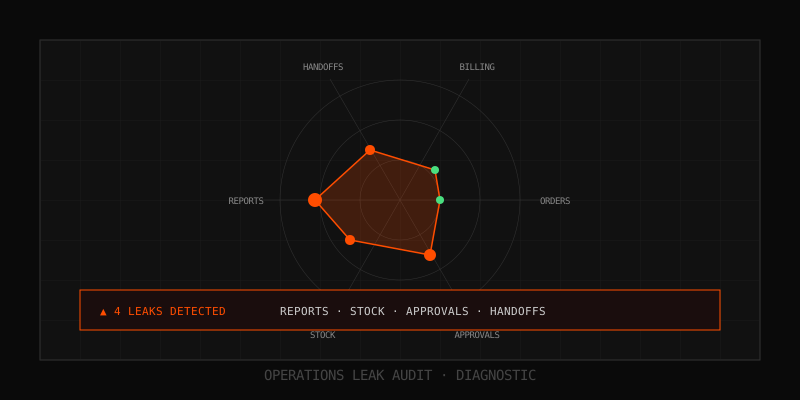
A 14-person ecommerce ops team we sat with last quarter had a familiar problem. Revenue was up 38% year-over-year. Headcount was up 22%. Margin was down 6 points. Their COO opened a Loom and said the quiet thing out loud: "Something is broken. I just can't tell you what." Three weeks later we could tell her exactly what: 11 hours/week bled into a duplicate fulfillment check, 6 hours/week in a Slack-to-spreadsheet copy ritual that existed because someone in 2023 didn't trust Shopify's order tags, and a returns process that had quietly become three processes nobody owned end-to-end.
Most operations leaders feel the friction every day. They just can't point at where it lives. Throughput is fine on paper. Tools are paid for. The team is busy. And yet something is leaking — time, margin, attention, morale. The Operations Leak Audit is a 90-minute structured diagnostic that surfaces those leaks specifically. Not a consultant's vibe check. A repeatable interrogation of your process surface area that produces a ranked list of leaks with named owners, estimated hours/week recovered, and a verdict on which ones are worth touching this quarter.
What an operations leak actually looks like
Most leaders imagine leaks as failures: a missed shipment, a customer complaint, a dropped ticket. Those are symptoms, not leaks. The leak is the structural reason the symptom keeps recurring. Five patterns cover roughly 90% of what we find:
- Ghost steps. Work that exists in the process but no longer serves a purpose. Someone added it. That someone left. Nobody removed it.
- Trust patches. Manual checks layered on top of automated systems because someone got burned once. The system is fine now. The check stayed.
- Tool sprawl seams. Data lives in 3 tools. Each team uses one. Reconciliation happens in spreadsheets at 11pm.
- Unowned interfaces. A handoff between two roles where neither side considers the handoff their job. Things sit. Things get re-asked.
- Hero dependencies. A process that works only because one person remembers how. If they're out, the process breaks. They're a constraint, not a savior.
These don't show up on a P&L. They show up as the slow, ambient feeling that the business is harder to run than it should be at its size. The audit's job is to name them, count them, and quantify them.
The 90-minute structure
Ninety minutes is not arbitrary. Shorter and you'll get a complaint inventory. Longer and the conversation drifts into strategy. Ninety minutes forces the depth of three problems and the breadth of a whole process surface. The block divides cleanly into five movements.
| Block | Minutes | Output |
|---|---|---|
| 1. Process surface map | 15 | List of every core process, owner, frequency, current tool stack |
| 2. Pain interview (Top 5) | 25 | The 5 processes the team complains about most, in their own words |
| 3. Leak-pattern interrogation | 20 | Each pain mapped to a leak type (ghost step, trust patch, etc.) |
| 4. Quantification | 20 | Hours/week per leak, recoverable hours, blast radius if ignored |
| 5. Verdict + ranked fix list | 10 | 3-tier priority list: fix now, fix next quarter, ignore |
You'll notice the audit doesn't start with "what's broken." It starts with "what exists." Nine out of ten ops leaders we meet have never written down their full process surface. They have it in their head. Their team has fragments of it. The first 15 minutes always produces a small shock — "huh, we have 23 recurring processes, not the 12 I thought."
Block 1: The process surface map
Every recurring activity gets a row. Order processing. Inventory reconciliation. Customer onboarding. Refund approvals. Vendor payments. Weekly reporting. Hiring. Performance reviews. Even the things that feel too small to mention — the Monday Slack standup that takes 45 minutes, the daily "did we ship everything?" check.
For each row we capture five fields: name, owner, frequency, tools touched, and a 1–5 friction score from the owner. The friction score is intentionally subjective. We're not measuring efficiency yet — we're measuring how much it hurts to do this work. A 5 means "I dread this." A 1 means "this runs itself."
The output looks like this in a typical 12-person services business:
| Process | Owner | Freq | Tools | Friction |
|---|---|---|---|---|
| Client onboarding | Ops Lead | ~3/wk | HubSpot, Notion, Slack, Gmail | 4 |
| Invoice approval | Finance | Daily | Xero, email, Slack | 3 |
| Weekly status report | Each PM | Weekly | Sheets, Slack, Notion | 5 |
| Vendor renewal review | Nobody named | "Quarterly" | Email folder | 5 |
Two patterns already jump off this table. The weekly status report gets a 5 from everyone who touches it — that's a structural problem, not a person problem. The vendor renewal review has no named owner and the frequency is in quotes because nobody actually knows. That's a leak before we've even asked a single follow-up question.
Block 2: The pain interview
Now we go deep on the five highest-friction processes. The interview question is not "what's wrong with this process?" That produces sanitized answers. The question is: "Walk me through the last time you did this. Where did it slow down or annoy you?"
Recency forces specificity. The team stops describing the platonic ideal of the process and starts describing the actual mess. Common answers we hear verbatim:
- "I have to ask Marco for the link because it's in his email."
- "I check the tag in Shopify, then I check the tag in ShipStation, because once they didn't match."
- "We have the data in HubSpot but the leadership dashboard pulls from Sheets so I export and paste."
- "The CFO wants it formatted differently than the COO so I make two versions."
- "Honestly I just do it manually because the automation broke six months ago and nobody fixed it."
Each of these is a leak. Each maps cleanly to one of the five patterns. The team often doesn't realize they're describing structural problems — they think they're describing minor annoyances. The audit's job is to recognize the pattern.
Block 3: Pattern interrogation
We take each named pain and run it against a short interrogation script. The script does one job: separate the symptom from the leak.
- Why does this step exist? If the answer is "I don't know" or "because someone said to," you're looking at a ghost step.
- What would break if we removed it? If the honest answer is "nothing for a while" — ghost step confirmed.
- What system are we double-checking and why? If the system is now reliable but the check remains, you have a trust patch.
- Where does the data actually live? If the answer involves three or more tools and a spreadsheet, you have a tool sprawl seam.
- Who owns the handoff itself? If neither side does, you have an unowned interface.
- What happens if this person is out for 2 weeks? If the process stops, you have a hero dependency.
Most pains map to more than one pattern. The weekly status report from the table above usually scores: tool sprawl seam (Sheets + Slack + Notion + email), unowned interface (PMs deliver, but nobody owns the consolidated result), and often a trust patch (the COO re-checks numbers because she got bad ones once). Three leaks in one ritual. That's normal.
Block 4: Quantification
This is the block that turns the audit from useful into operative. Every named leak gets three numbers.
- Current cost. Hours/week spent on the leaky portion of the process across all people who touch it.
- Recoverable hours. Of those hours, how many disappear entirely if the leak is fixed properly (not all of them — some work just becomes faster, not zero).
- Blast radius. What else gets worse the longer this leak runs? Customer impact, error rate, team morale, hiring pressure.
Don't get cute with the math. Round generously. The audit's credibility comes from the team agreeing the numbers feel right, not from them being defensible in a board meeting. A simple recovered-hours table from a real audit:
| Leak | Pattern | Hrs/wk now | Recoverable | Blast radius |
|---|---|---|---|---|
| Weekly status report ritual | Tool sprawl + unowned interface | 11 | 8 | Leadership decisions delayed; PMs demoralized |
| Shopify/ShipStation dual-tag check | Trust patch | 6 | 5.5 | Low — but pure waste |
| Vendor renewal review | Ghost owner | 0 (until it isn't) | N/A | High — surprise auto-renewals, missed cancellations |
| Refund approval chain | Hero dependency on Finance Lead | 4 | 2.5 | Customer wait time, NPS |
| Client onboarding Notion vs HubSpot | Tool sprawl seam | 5 | 3 | Data quality, new-hire ramp time |
Five leaks. 26 hours/week of current cost. 19 hours/week recoverable if fixed. In a team that costs roughly €60/hour fully loaded, that's about €4,940/month bleeding into work that doesn't need to exist. And those numbers don't include the blast-radius impacts that don't show up as hours.
Block 5: The verdict
Not every leak is worth fixing. Some are small, some are politically expensive, some are about to be solved by a platform change you're already planning. The final 10 minutes ranks leaks into three buckets.
- Fix now. High recoverable hours, low fix complexity, clear owner candidate. Usually 2–3 leaks.
- Fix next quarter. Material impact but requires sequencing — tool consolidation, hiring, policy changes.
- Ignore (with intent). Real leaks that aren't worth touching this year. Documenting them as "knowingly accepted" is more valuable than pretending they don't exist.
The "ignore with intent" bucket is the one most consultants skip and most ops leaders quietly need. A leak you've decided to live with is a manageable risk. A leak you've forgotten about is a future fire.
What the deliverable actually contains
At the end of 90 minutes the team walks out with one document. Not a 40-page deck. A single page per leak with: the process it lives in, the pattern type, the hours/week cost and recovery estimate, the blast radius, the proposed owner, and a one-sentence fix hypothesis. Plus a single ranked summary table at the front so leadership can see the whole landscape on one screen.
That document is what makes the audit operative instead of decorative. You can hand it to a department head and say "this is your quarter." You can put it in a board update. You can use it to justify a hire or kill a tool. Most importantly, the next audit — 6 or 12 months out — has a baseline to measure against. The leaks you fixed actually got fixed, or they didn't, and now you know which.
Why most teams skip this and pay for it later
We hear three objections regularly. None of them hold up under examination.
"We don't have 90 minutes." The team is currently spending 19 hours/week on leaks they haven't named. The audit pays itself back in the first week post-fix. The math isn't close.
"We know what's broken — we just need to fix it." Usually false. The team knows what hurts. They rarely know which hurt is structural vs. circumstantial, and they almost never know the ranked order. Picking the wrong leak to fix first is how ops projects die in month three.
"This is what consultants charge $40k for." Some do, and you get a 60-page deck. The audit described here is 90 minutes and produces a one-pager-per-leak. The constraint is what makes it useful. We run this as a Operations Leak Audit precisely because the structure does the work — there's no point hiding it behind a paywall when most teams will fix the easy leaks themselves once they're named.
What separates a leak audit from a process audit
Traditional process audits map flows, document SOPs, and recommend optimizations. They're useful for compliance and onboarding. They're slow, expensive, and they tend to make existing processes more rigid rather than questioning whether the processes should exist at all.
A leak audit asks a different question. Not "how do we run this process better" but "should this process exist in this form at all, and if not, what's the smallest change that makes the leak stop?" A trust patch doesn't need a better SOP — it needs to be deleted. A hero dependency doesn't need documentation — it needs a second person trained or a workflow rebuilt so heroism isn't required.
This is also why the audit produces fix hypotheses rather than full implementation plans. The right fix for a ghost step is removal. The right fix for a tool sprawl seam is usually consolidation, sometimes integration. The right fix for an unowned interface is naming an owner, full stop. You don't need a 12-week engagement to figure that out. You need 90 focused minutes and someone asking the right questions.
How OpsMavix Approaches This
We built the Operations Leak Audit because we kept watching SMB ops leaders pay for things they didn't need — full-blown process re-engineering engagements, software platforms with onboarding fees larger than the problem, consultants who delivered frameworks instead of fixes. The 90-minute structure is the smallest unit of diagnostic work that actually moves the needle. We don't think it should be locked behind a procurement cycle.
OpsMavix runs the audit for SMB ops teams. You walk out with the ranked leak list, the hours/week recovery estimates, and the one-pager-per-leak deliverable. If you want help implementing the fixes after, we'll quote you for that — but most teams take the document and start fixing leaks themselves the same week. That's the point. A diagnostic that doesn't give you something usable on day one isn't a diagnostic, it's a sales call wearing a lab coat.
If you're an ops leader who knows something is broken but can't name what, book the audit at opsmavix.com. Ninety minutes. Real output. No pitch deck. If at the end you decide you want to handle the fixes yourself with the document we produce, that's a good outcome. If you decide you'd rather have help with the gnarly ones, we'll talk. Either way you'll know exactly where your business is bleeding time — and which leaks are worth the wrench.
Learn more: How it works · Why bundles beat raw thread history