
Thread Transfer
When Inventory Spreadsheets Start Costing You Real Money
Three spreadsheets, none agreeing, all out of date. By the time someone catches the mismatch, you've oversold a bestseller. The real cost isn't the spreadsheet — it's everything downstream.
Thread Transfer
Operations Systems for SMBs
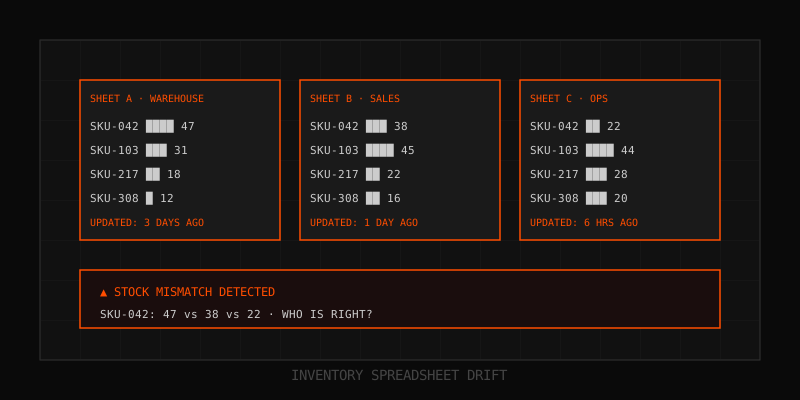
It's 4:47pm on a Friday. A wholesale customer just placed an order for 240 units of your best seller. The Shopify backend says 312 in stock. Confident. You confirm the order. Monday morning your warehouse manager calls — actual physical count is 88 units. The spreadsheet your bookkeeper kept in parallel says 156. The supplier portal where you log incoming POs says 412 are inbound, but the ETA was three weeks ago. Nobody has updated anything since the long weekend.
You now have three numbers, all wrong, and a customer expecting a Tuesday shipment. This is what an inventory spreadsheet failure actually looks like — not a dramatic outage, just a slow drift between what's on the shelves and what your systems claim. By the time anyone notices, the damage is already in the email chain.
The Hidden Tax Nobody Lines Up On the P&L
Most operators don't think of spreadsheets as expensive. They're free. They came with the laptop. Excel doesn't send invoices. But every spreadsheet-based inventory system carries an invisible tax that shows up across at least six line items downstream. Once you start adding them up, the "free tool" gets very expensive very fast.
Here's a real breakdown from a mid-sized ecommerce client we audited last quarter. They were doing about EUR 1.4M in annual revenue across roughly 380 SKUs, managing stock across two warehouses with a master Google Sheet and two satellite sheets the warehouse team updated by hand.
| Hidden Cost | How It Shows Up | Annual Cost |
|---|---|---|
| Stockouts on bestsellers | 17 events/year, avg EUR 1,800 lost margin each | EUR 30,600 |
| Overselling refunds + chargebacks | 43 events, avg EUR 95 refund + comp shipping | EUR 4,085 |
| Emergency air freight on missed reorders | 6 panic shipments, EUR 1,200 surcharge each | EUR 7,200 |
| Dead stock that should have been promoted earlier | EUR 22K tied up, 14 months later cleared at 60% off | EUR 13,200 |
| Manual stock-take labor (3 people, 2 days, quarterly) | 48 person-hours x 4 x EUR 22/hr | EUR 4,224 |
| Bookkeeper reconciliation time | ~6 hrs/month at EUR 45/hr | EUR 3,240 |
| Total annual spreadsheet tax | EUR 62,549 |
That's not a hypothetical. That's one business, one year, one accounting reality. The owner thought the inventory was "managed" because someone was always updating the sheet. The sheet was always being updated. The sheet was also always wrong.
Why Spreadsheets Fail at Inventory Specifically
Spreadsheets are excellent for ad-hoc analysis, modeling, and reporting. They are catastrophic for operational state — the kind of data that changes by the minute and must reflect physical reality. The reason isn't the tool. It's the structural mismatch between what inventory needs and what a spreadsheet can offer.
No Single Source of Truth
Inventory updates happen in at least four places: the sales channel (Shopify, Amazon, wholesale portal), the warehouse floor, the receiving dock, and the finance team. A spreadsheet sits on one person's screen. When two people edit at once — even in Google Sheets — race conditions delete each other's work. When the warehouse team writes counts on paper at 6am and the bookkeeper transcribes them at 3pm, you have a nine-hour blind spot every day.
No Real-Time Channel Sync
Your Shopify store sold 8 units while you were having lunch. Your spreadsheet doesn't know. Your Amazon listing sold 3. Your spreadsheet doesn't know. Your wholesale customer placed a phone order for 15. Your spreadsheet doesn't know. By the time someone manually updates the sheet that evening, you may have already promised stock you no longer have to three different customers.
No Reorder Alerts
A spreadsheet can hold a "reorder point" column. It cannot tell you when you've crossed it. It cannot ping your phone. It cannot email your supplier. Reorder logic in a spreadsheet only works if a human opens the file, scrolls to the right cell, and notices a number is red. Most reorder misses happen because nobody looked.
No Lead Time Math
Real reorder logic isn't "when stock drops below 50, buy more." It's "given my current sell-through rate, my supplier lead time of 28 days, and my safety stock target, when do I need to fire the PO to avoid running out?" That equation needs daily recalculation against actual sales velocity. Spreadsheets can do the math; they can't do the watching.
No Audit Trail
Who changed cell D47 from 312 to 88? When? Why? In most spreadsheets, the answer is "nobody knows." Version history helps in Google Sheets, but try reconstructing a six-month dispute about a phantom write-off and you'll see how brittle that audit trail really is.
The Five Symptoms That Mean You've Outgrown Spreadsheets
Most operators recognize the problem only after a serious incident. By then the damage is already booked. Here are the earlier signals — the ones that show up months before the disaster.
- Customer-facing surprise. A customer service rep has to email a customer that "the system showed stock but we actually don't have it." If this has happened more than twice in a quarter, your stock data is structurally broken.
- Reorder-by-vibes. Your purchasing decisions are based on "I think we're getting low on the blue ones" instead of a dashboard number. Vibes scale until they don't.
- Quarterly stock-take shock. Every physical count reveals 5%+ variance from system stock. Anything above 2% means you can't trust the system for any decision that touches revenue.
- The "let me check and get back to you" delay. A wholesale customer asks "can you ship 200 by Friday?" and nobody can answer without walking to the warehouse. That is the sound of money leaving — competitors with real systems answer in 4 seconds.
- The one person who knows. Inventory only makes sense to one human in the building. When they're on vacation, ops grinds. When they quit, you have a forensic project on your hands.
What a Real Stock Control Dashboard Replaces
The fix isn't "buy bigger software." The fix is to consolidate the four data streams (sales, warehouse, receiving, finance) into a single state machine that any team member can read in three seconds. A proper inventory automation system eliminates the human polling loop entirely. Sales channels push updates as they happen. The warehouse confirms picks via a scanner, not a spreadsheet row. Receiving updates inbound POs the moment goods hit the dock. Reorder logic runs continuously in the background, not when someone remembers to check.
Here's the practical before/after for the same EUR 1.4M business above, six months after replacing the spreadsheet stack:
| Operational Reality | Spreadsheet System | Automated System |
|---|---|---|
| Stock accuracy at any given moment | 85-92% | 99.4% |
| Time to answer "do we have 200 of X?" | 20-45 minutes | 4 seconds |
| Reorder decisions per week requiring human guessing | 12-18 | 0 (system surfaces them) |
| Stockout events per quarter | 4-5 | 0-1 |
| Quarterly physical stock-take labor | 48 person-hours | 6 person-hours (spot check) |
| Bookkeeper monthly reconciliation | 6 hours | 30 minutes |
| Dead stock identified within | 9-14 months | 21 days |
The Three Pieces Most Operators Get Wrong
When businesses try to replace spreadsheets, they usually buy a generic inventory SaaS, run into edge cases their workflow doesn't fit, and quietly fall back to the spreadsheet. The reason isn't the software — it's that they didn't replace the three pieces that actually matter.
1. The Reorder Alert System
A real reorder alert system doesn't just say "you're low." It calculates a reorder point per SKU based on rolling 30/60/90-day velocity, supplier lead time, and a safety stock buffer. It fires the alert to the right person via the channel they actually check (usually Slack or SMS, not email), and it includes a one-click "create draft PO" action. If reordering takes more than 90 seconds, people defer it. If it takes 5 minutes, they forget.
2. The Multi-Channel State Sync
Inventory only makes sense as a single number. If Shopify thinks 312 and Amazon thinks 280 and the warehouse knows 88, you don't have an inventory system — you have three opinions. Every sales channel must read from and write to the same source of truth, in real time. Cron jobs that sync every 4 hours are not enough. A bestseller can sell out twice in 4 hours.
3. The Receiving Confirmation Loop
Inbound stock is the most commonly broken part of every spreadsheet system. POs get created and forgotten. Suppliers ship late. Partial shipments arrive. Damaged units go back. A real system treats every PO as a live object with an expected arrival, an actual arrival, a received quantity, and a variance log. Most spreadsheet systems just have a "qty ordered" column and a vibe.
When to Stop Patching and Rebuild
The honest answer: when the annual spreadsheet tax exceeds the cost of a real system. For most businesses in the EUR 500K-3M revenue range, that crossover happens far earlier than they think. We typically see it once a company is past 150 active SKUs or running on more than one sales channel.
A useful test: take your last four stockout incidents and total the lost margin plus refunds plus emergency shipping plus staff time chasing the problem. If that number exceeds EUR 8,000, you're already paying for the system. You just aren't getting it.
What "Custom" Actually Means Here
Off-the-shelf inventory SaaS works fine for vanilla ecommerce. It breaks the moment your workflow has any wrinkle: kitting, bundles, multi-warehouse with internal transfers, B2B with quoted pricing, consignment stock at retailer locations, refurbished returns flowing back into sellable inventory. These are not edge cases — they are how real businesses operate. Custom inventory automation means the system bends to your workflow rather than forcing your workflow to bend to a SaaS data model.
How OpsMavix Approaches This
At OpsMavix, we don't sell software. We build custom operations systems that replace the spreadsheet-and-prayer stack with infrastructure your team can actually rely on. For inventory specifically, that usually means three things: a single state-of-stock database that every sales channel reads from in real time, a reorder alert engine that fires on velocity-based logic instead of fixed thresholds, and a receiving workflow that closes the loop between PO creation and physical arrival.
We start with a Operations Leak Audit — a 45-minute working session where we map the actual flow of stock data across your business, identify where the leaks happen, and quantify the annual cost. No deck. No pitch. You leave the call with a one-page diagnostic whether you work with us or not. Most operators are surprised by how much of the "spreadsheet tax" is sitting in plain sight once someone draws the picture.
If you've recognized your business anywhere in this article — the Friday afternoon oversell, the quarterly stock-take shock, the customer email that starts with "I'm so sorry but" — book the audit at opsmavix.com. The audit takes less time than reconciling one month of your current sheets, and the math usually pays for itself before you finish the call.
Learn more: How it works · Why bundles beat raw thread history