
Thread Transfer
Custom Operations System vs ERP vs SaaS: Which Is Right for a $5M Business?
Most operations leaders compare ERPs and SaaS and pick the lesser pain. There's a third option — purpose-built custom systems — that solves what both of the others can't.
Thread Transfer
Operations Systems for SMBs
A $6M manufacturing client of ours spent 14 months trying to make NetSuite work. They paid $94,000 in license and implementation fees, $38,000 in consultant hours, and lost an estimated $200,000 in productivity while production controllers fought a system designed for businesses ten times their size. They eventually ripped it out and replaced it with a custom-built operations layer that took 9 weeks to deploy and cost less than half of what they had already burned.
This is not an unusual story. It is the default outcome for businesses between $1M and $25M in revenue who treat the software decision as a binary: ERP or SaaS. There is a third option — purpose-built custom operations systems — that most operations leaders never seriously evaluate, usually because the wrong consultants told them custom means "expensive, risky, and slow." That was true in 2014. It is no longer true in 2026.
The Three Categories, Stripped Of Marketing
Before comparing, let's define what each category actually is once you remove the brochure language.
ERP (Enterprise Resource Planning)
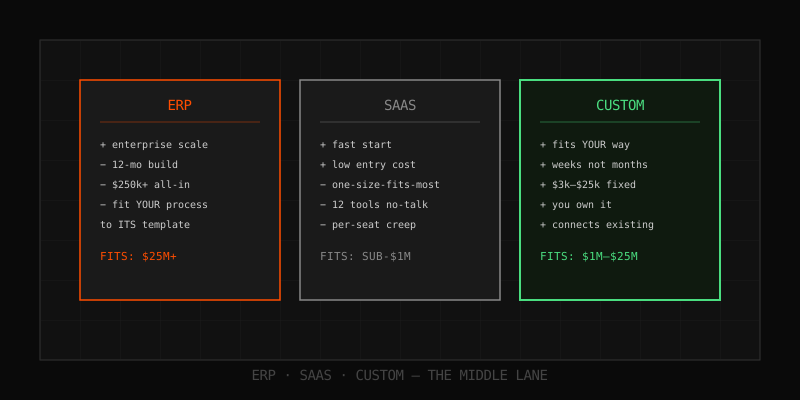
NetSuite, SAP Business One, Microsoft Dynamics, Oracle. Monolithic platforms built for businesses with complex inter-departmental workflows — typically $25M+ revenue, multi-entity, multi-currency, with finance, HR, supply chain, and operations needing to share a single source of truth. ERPs are configured, not built. You bend your processes to fit the system, not the other way around.
SaaS (Point Solutions)
QuickBooks for accounting, Shopify for ecommerce, Monday or Asana for project management, Fishbowl for inventory, Gusto for payroll. Each tool solves one problem well. Most SMBs end up running 8 to 15 of them stitched together with Zapier, manual exports, and a fragile Google Sheet that one person on the ops team understands.
Custom Operations System
A purpose-built application that codifies your specific workflows — the way your business actually runs — into a single system. Modern stack (TypeScript, Postgres, React, hosted on Vercel or Cloudflare), built in 6-12 weeks, owned outright. Not a Salesforce customization. Not a $400K Odoo implementation. A real, narrow, sharp tool.
The Honest Comparison Table
Here is what the three options actually look like for a $5M business across the dimensions that matter operationally.
| Dimension | ERP (NetSuite/SAP) | SaaS Stack (8-15 tools) | Custom System |
|---|---|---|---|
| Year 1 cost | $80K–$250K | $24K–$60K | $40K–$120K |
| Year 2-5 recurring | $60K–$150K/yr | $30K–$80K/yr (grows) | $8K–$20K/yr (hosting + maintenance) |
| Time to working system | 9–18 months | 2–6 weeks per tool | 6–12 weeks |
| Fits your actual process | No — you reshape to it | Partial — gaps filled by humans | Yes — built around it |
| Single source of truth | Yes | No — data scattered | Yes |
| Speed of change request | 3-6 months + consultants | Wait for vendor roadmap | Days to 2 weeks |
| Vendor lock-in risk | Extreme | Per-tool (compounds) | Low (you own the code) |
| Staff training overhead | High (generic UI) | High (many UIs) | Low (your language, your flow) |
Where Each One Actually Wins
This is the part nobody puts in their sales deck. Each of the three is genuinely the right answer for some businesses. Knowing which bucket you're in saves six figures.
When ERP is the right call
- Revenue above $25M with multiple legal entities or international operations
- You have a dedicated IT department with 3+ people
- Auditors, lenders, or PE owners require a Tier 1 ERP for compliance reasons
- Your processes are genuinely standard — you're doing what a thousand other companies in your industry do, the same way
- You have the patience and budget for an 18-month implementation
When SaaS-only is the right call
- Revenue under $1M with simple workflows and 1-5 employees
- Your business is genuinely "off the shelf" — standard ecommerce, standard agency model, standard SaaS sales
- You have no operations leader yet and need something running tomorrow
- You're testing the business model and might pivot in 6 months
When Custom is the right call
- Revenue between $1M and $25M and your edge is process-based, not just product-based
- You currently have a "spreadsheet that runs the business" — usually production scheduling, inventory allocation, job costing, or quoting
- Your ops team spends 10+ hours/week on manual data movement between tools
- You've outgrown SaaS but ERP feels like swallowing a battleship
- You have a process that is your competitive moat — and no SaaS captures it
The Hidden Cost SaaS Stacks Never Show You
When operations leaders compare a $300/month SaaS tool to a $60K custom build, they almost always pick the SaaS tool. The math looks obvious. It isn't. Here's what the comparison actually looks like over 3 years for a typical $5M business running a stitched SaaS stack vs. a custom system:
| Cost line | SaaS stack (3 yrs) | Custom system (3 yrs) |
|---|---|---|
| Software subscriptions (8-12 tools) | $108,000 | $0 |
| Zapier / Make / integration glue | $18,000 | $0 |
| Hosting + infra (custom only) | $0 | $7,200 |
| Build / implementation cost | $15,000 | $70,000 |
| Maintenance / iteration | $0 (vendor's problem) | $24,000 |
| Manual data movement (2 FTE hrs/day @ $35/hr) | $54,600 | $5,000 |
| Errors, missed orders, reconciliation pain | $40,000+ (estimated) | $3,000 |
| 3-year total | $235,600 | $109,200 |
The SaaS sticker price is the lie. The real cost of a multi-tool SaaS stack is the human glue holding it together — and that human glue is your ops manager, your warehouse lead, your bookkeeper, doing work that should not exist.
The Three Questions That Decide It
Forget vendor demos. The decision compresses into three honest answers:
1. Is your process generic or specific?
Run this test: describe your operations to a competitor. If they say "yeah, same here," you're generic — SaaS or ERP works. If they say "wait, how do you do that?" — that's where your moat is, and no off-the-shelf tool will respect it. A custom system codifies that moat instead of erasing it.
2. How often does your process change?
If you add a new product line, a new customer type, or a new fulfillment method every 6 months, ERPs will crush you with change-order fees. SaaS will leave you stitching new tools in. Custom systems built on modern stacks can absorb a process change in days, not quarters.
3. What does "one source of truth" mean to your finance team?
If your CFO is reconciling three systems every month-end and your inventory number disagrees with your accounting number disagrees with your warehouse number — you have already paid for a custom system, you just haven't built it yet. The cost is being burned, monthly, in human reconciliation hours and bad decisions made from wrong data.
The Real Reason Custom Got Cheap
The "custom is expensive" reputation is a 2014 fact that lived past its expiry date. Three things changed:
- Modern frameworks compress timelines. Next.js, Prisma, Postgres on managed hosting (Supabase, Neon, Cloudflare D1) — what used to take 6 months of backend engineering now takes 3 weeks.
- AI-assisted development is real. Cursor, Claude Code, and similar tools have made small senior teams 2-3x more productive on focused build work. A 2-person team in 2026 ships what a 5-person team shipped in 2022.
- Hosting is cheap. A custom app for a $5M business now runs on $200/month of infra, not the $4,000/month it cost on AWS dedicated instances in 2018.
This is why teams like OpsMavix can deliver a working custom operations system in 6-10 weeks for the price of one year of NetSuite licensing. The economics flipped, but most operations leaders are still pricing custom against a 2015 reality.
What "Custom" Should Actually Look Like in 2026
Custom does not mean "we'll build you everything from scratch including the accounting." That's how custom projects fail. Modern custom looks like this:
- Keep what works. QuickBooks for accounting. Shopify for the storefront. Gusto for payroll. These are solved problems.
- Build the ops core. The piece that's unique to your business — production scheduling, job costing, quoting, inventory allocation, customer-specific pricing logic, route planning, whatever runs in a spreadsheet today.
- Integrate, don't replace. The custom core pulls and pushes data to the SaaS edges via API. One source of truth in the middle, specialized tools on the edges.
For a manufacturer, this often means a custom production tracking system connected to QuickBooks for AR/AP and to Shopify or a custom B2B portal for orders. For a services business, it's typically a job costing + scheduling + utilization core that feeds payroll and invoicing. For a distributor, it's inventory + allocation + pick-pack-ship with the accounting and ecommerce sitting on the edges.
The Migration Path Most Don't Realize Exists
If you're currently drowning in a SaaS stack and considering NetSuite — pause. There's a sequence that works better and costs less:
- Map your data flow. Where does data start, where does it land, who touches it on the way. Two weeks of work, often reveals the answer.
- Identify the bottleneck process. The one workflow that, if fixed, eliminates 60% of your operational pain. Usually it's quoting, scheduling, or inventory allocation.
- Build the custom core around that. 6-10 weeks. Replaces 3-4 SaaS tools and the spreadsheet duct tape between them.
- Keep the edges. Accounting stays in QuickBooks. Email in Google Workspace. Don't rebuild solved problems.
- Iterate. Add the next workflow when the first one is stable. Custom systems should grow in 2-week increments, not 18-month phases.
The Decision Framework, One Page
If you want the answer in 60 seconds:
- Under $1M revenue, generic business model: SaaS stack. Stop overthinking.
- $1M–$25M, process is your moat, spreadsheet runs the business: Custom operations system. This is the sweet spot.
- $25M+, multi-entity, audit/PE pressure: ERP. Pay the tax. It's worth it at that size.
- $25M+, but your process is still genuinely unique: Custom core + ERP for finance only. Don't let ERP eat operations.
How OpsMavix Approaches This
The reason most $5M businesses pick the wrong system isn't ignorance — it's that the only people who do assessments are ERP resellers and SaaS sales reps, and both will tell you the answer is whatever they sell. Independent diagnosis is rare.
OpsMavix runs a Operations Leak Audit that does exactly that diagnosis: maps your current data flow, identifies the manual handoffs that are costing you actual money, and tells you honestly whether you need a custom system, a better SaaS stack, or just to clean up the one you have. About 30% of the audits we run end with "you don't need us — fix these three things in your existing stack and revisit in a year." That's not generosity. It's the only honest answer when the answer is "no."
If you're somewhere between $1M and $25M and you suspect you've outgrown the spreadsheet but you're not ready to surrender 18 months and $150K to NetSuite, the audit is worth the hour. Book the Operations Leak Audit at OpsMavix — we'll tell you which of the three categories you actually belong in, with the numbers to back it up.
Learn more: How it works · Why bundles beat raw thread history